

When politicians refuse to engage with a presidential chief of staff, it signals more than personal animus; it marks a boundary line in how power, policy, and moral language now operate in Washington’s immigration fights.
The Short Version
- Hakeem Jeffries publicly rejected Stephen Miller as a negotiating counterpart, calling him a “stone-cold racist,” and tied that stance to Miller’s authorship of hardline immigration policies.
- Miller’s central role in designing and driving aggressive immigration measures is well documented across mainstream reporting; defenders frame those measures as necessary border enforcement.
- The clash reflects a broader trend: immigration debates are moralized and personalized at the national level, elevating advisers into symbols of entire agendas.
- What looks like a character dispute is also a strategy choice about where and how to bargain — directly with the president, not through a polarizing aide.
What Jeffries said, and why it mattered
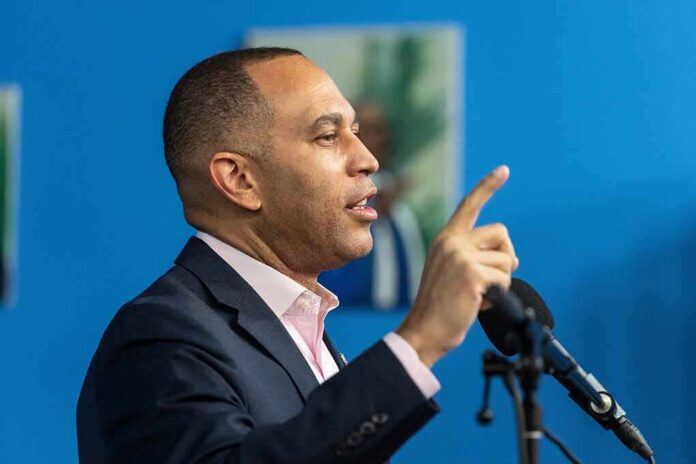
Hakeem Jeffries did not duck or euphemize. Asked whether Stephen Miller, newly installed as White House chief of staff, could be a viable partner for legislation, he answered that “Stephen Miller is a stone cold racist,” adding that Miller’s “track record speaks for itself” and that he had “zero interest” in working with him. The remark was neither a leak nor an offhand aside; it was a deliberate on-camera boundary. In legislative practice, drawing that line shifts the venue of any bargaining. Jeffries simultaneously left the presidential channel open — an old Washington move — while foreclosing staff-mediated backchannels with a figure he presented as inseparable from an immigration approach he deems beyond the pale.
This was not a free-floating epithet. Jeffries has long linked Miller to the design of the administration’s most aggressive immigration moves. That linkage is not novel opposition research; it matches years of reporting that situate Miller as a key driver of travel restrictions, family separation under “zero tolerance,” refugee admissions cuts, and expanded enforcement — the hard kernel of the administration’s restrictionist program.
Stephen Miller as policy architect, not just lightning rod
Every presidency produces a handful of aides who become metonyms for a policy direction — think Karl Rove on political strategy or Valerie Jarrett on Obama-era inner-circle governance. Miller’s imprint is policy-forward: a preference for maximal executive-led immigration control, and a sustained effort to harden the architecture of enforcement, narrow legal migration pathways, and recenter “public charge,” skills-based selection, and labor-market protection arguments. Even sympathetic accounts present him as an “accelerant of executive power,” a phrase that captures both method and ambition in reworking immigration through regulation, guidance, and prosecutorial posture rather than sweeping new statutes.
That public record — White House briefings, on-the-record defenses of zero-tolerance, and the internal push for restrictive measures — explains why critics and supporters both treat Miller as an avatar of the agenda rather than a faceless facilitator. The debate is therefore less about whether he was materially involved (he was) and more about whether that program is an enforcement necessity or a moral transgression.
The counter-case and its limits
Defenses of Miller tend to run on two rails. First, they assert policy prudence: strong borders require tough choices; zero-tolerance signals resolve; skills-based green card criteria protect American workers. President Trump’s own defense leans on this argument of necessity and strength at the border. Second, character witnesses — often former colleagues — offer personal testimonials that Miller is thoughtful, prepared, and courteous in private settings. Those points may contextualize style and intent, but they do not refute the public record of the policies themselves or the political choice to elevate moral language in contesting them.
Notice what is absent: a direct, sourced rebuttal from Miller that contests Jeffries’s characterization point by point, or a counterfactual timeline that reallocates authorship of those initiatives. In the absence of such specific contradiction, the dispute remains squarely about judgment — whether the program Miller advanced constitutes legitimate enforcement or crosses into discriminatory ideology — not about whether he advanced it.
Why the rhetoric is so sharp now
National politics increasingly speaks in moral registers about immigration. As parties polarize, persuasion gives way to mobilization, and mobilization thrives on bright moral boundaries. Research across democracies shows parties moralize immigration more as they move further apart on the issue; in U.S. national discourse specifically, abstract, moralized, and power-centric language is more prevalent than in local political arenas. That linguistic shift helps explain why labels like “racist,” “cruel,” or “architect” appear more frequently in high-level disputes: they do movement work by clarifying in-group and out-group identities, even as they make cross-faction bargaining harder.
Personalization is the other force at work. Modern presidential systems tend to attribute sweeping intention to a few recognizable advisers. That can be analytically misleading — authority still runs through the president, agencies, and courts — but politically potent. Jeffries’s refusal to use Miller as an intermediary was therefore not performative alone; it was a structural choice to strip symbolic legitimacy from a policy locus he rejects while keeping a path to the Oval Office intact.
Governance implications: channels, leverage, and the cost of clarity
Refusing to meet with a chief of staff narrows the plumbing through which deals move. Chiefs broker everything from minor calendar trades to major legislative frameworks. Cutting that conduit has three effects. First, it raises the transaction cost of agreement; more work must occur leader-to-leader or via committee liaisons. Second, it can increase leverage for the refusing side, especially if the president values a legislative win enough to engage personally. Third, it can lock in reputational stakes — if the aide’s policy brand is central to the White House identity, excluding him publicly may make compromise less, not more, likely.
In practice, Congress and the White House often run parallel tracks: public postures that harden identity, and private conversations that explore landing zones. By defining an unacceptable intermediary while leaving the principal channel ajar, Jeffries attempted to square those two imperatives. Whether that works depends on presidential incentives, not staff preferences. In this case, the substance on the table — the scope and method of immigration enforcement — is precisely where the White House has sought to exercise executive initiative. That tilts against a staff work-around and toward direct confrontation or direct presidential engagement.
How to read this going forward
Three durable truths will shape the arc. One, on authorship: Miller’s role in conceptualizing and advancing hardline immigration measures is established in mainstream reporting; disputes center on values and consequences, not on whether he mattered. Two, on language: moralization will persist as long as immigration remains a core identity issue in national politics; it is a feature of the media and party system, not a temporary fever. Three, on process: leaders will continue to calibrate access to staff as a form of pressure while preserving head-of-government channels when they want outcomes rather than optics. If an immigration bargain emerges, it will come from presidential calculations about trade-offs — enforcement for legalization, resources for rule changes — not from rehabilitating the public image of a polarizing aide.
Sources:
hindustantimes.com, pennlive.com, rmb.reuters.com, thehill.com, csmonitor.com, thedailybeast.com, businesstimes.com.sg