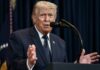


When a sitting president leans on a corporate board over who should be CEO, the line between legitimate statecraft and improper interference stops being theoretical and starts shaping markets, governance standards, and national-security practice in real time.
The Short Version
- President Trump publicly urged Nvidia to rehire Jensen Huang and said he spoke with directors “directly and indirectly,” describing his role as decisive.
- Nvidia’s board reversed course and unanimously reinstated Huang within days, saying it had input from “senior levels of the United States government.”
- Officials framed the intervention as anchored in national-security assurances rather than ordinary corporate preference.
- The record establishes influence, not a prosecutable quid pro quo; allegations of personal financial gain or stock manipulation remain unproven in the cited reporting.
What Happened: A Presidential Nudge Meets a Boardroom Reversal
Multiple outlets reported that President Trump publicly pushed Nvidia’s directors to reinstate Jensen Huang and claimed personal involvement in the outreach. In on-air remarks, Trump said he spoke with board members “directly and indirectly,” that he “convinced them,” and that his intervention “was very important.” Nvidia’s board, which had recently rejected Huang’s return, reversed course and delivered a unanimous vote to reinstate him; the company’s statement cited input from senior U.S. government officials and expressed confidence there was “no national security risk.” The sequence was abrupt enough for Reuters and the Associated Press to characterize it as a reversal following the president’s urging.
Two elements make this episode consequential beyond its headline drama. First, the White House cast its engagement as addressing national-security concerns—an assurance Nvidia said informed its risk judgment. Second, the board delivered unanimity and publicly vouched for Huang’s leadership and candor, giving the decision institutional cover that blunts the clean narrative of brute coercion. Those features anchor this case in the gray zone where public power and private governance routinely intersect.
Mechanism: How Government “Assurances” Move a Private Board
When a company sits at the fulcrum of a strategic technology—advanced AI accelerators in Nvidia’s case—directors face an inescapable dual mandate: maximize long-run enterprise value and mitigate national-security exposure. Government information, even when shared informally, can change the calculus on both. An assurance that a contemplated leadership choice poses “no national security risk” de-risks regulatory, enforcement, and supply-chain uncertainty; it can also re-frame fiduciary duty by reducing the probability of catastrophic downside scenarios that directors must guard against. That is especially true in export-controlled domains where regulators’ posture can shape everything from license approvals to customer screening burdens. Nvidia explicitly said senior U.S. government input contributed to its conclusion on risk and its unanimous reinstatement.
Presidents and cabinet officials have long used informal channels—phone calls, meetings, and public signaling—to influence private decisions without issuing an order. The tool is soft power backed by the potential for hard power: antitrust scrutiny, export licensing, procurement preferences, or national-security reviews. The practice is not per se unlawful; it is also not costless. Each use sets a precedent about when and how the state will reach into boardrooms under the banner of national interest, a precedent that strategic industries will internalize the next time the phone rings.
Precedent and Norms: This Is Not Entirely New, But the Domain Matters
There is lineage here. Presidents have confronted steelmakers over prices, shaped restructurings during the auto rescue, and leaned into foreign-investment reviews. The commonality is national leverage deployed at decisive corporate moments. What distinguishes the Nvidia case is the confluence of factors: a CEO-specific decision, the centrality of AI chips to U.S. technological primacy, and the explicit invocation of national-security assurances as the basis for reinstatement. In that respect, the case reads less like political meddling for its own sake and more like the government’s increasingly hands-on approach to governing critical technologies, where the boundary between shareholder value and state objectives is porous by design.
Where The Evidence Is Firm—and Where It Is Not
On the facts, several pillars are sturdy. Trump himself publicly claimed influence over the board’s decision and framed his involvement as necessary “for the country.” Multiple mainstream outlets independently reported the outreach and the timeline: public urging, then an abrupt unanimous reinstatement. Nvidia’s statement acknowledged senior U.S. government input on the national-security dimension. These are on-record, attributable claims, not rumor.
By contrast, the most serious accusations that often swirl around episodes like this—bribery, quid pro quo, direct stock trading, or an intent to manipulate securities—are not established by the cited reporting. The coverage documents a forceful presidential intervention and a board reversal; it does not identify trades by Trump, a payment stream tied to the action, or a prosecutable exchange of favors. Nor do we have public board minutes, investigative files, or sworn director testimony to adjudicate the internal deliberations or the precise content of government assurances. In other words, the record supports influence and norm strain; it does not, on its face, prove corruption in the legal sense.
The National-Security Frame: Assurance as Strategy and as Shield
National security is not a rhetorical garnish in the semiconductor domain; it is a daily operating constraint. A government statement that a CEO’s return poses no national-security risk can function in two ways. Strategically, it signals that the administration’s security apparatus sees no disqualifying exposure—critical in an environment of tight export controls and scrutiny of technology flows to adversarial end users. Procedurally, it provides directors with a defensible rationale for their decision, one aligned with their duty to consider enterprise-threatening risks. Nvidia said precisely that—government input informed a no-risk conclusion and a unanimous vote—which simultaneously addresses investor anxiety and mitigates litigation exposure alleging reckless disregard of security risks.
Critics will worry, with reason, about information asymmetry. If the same executive branch that possesses the investigative and licensing levers also supplies the exonerating assessment, outsiders cannot evaluate the basis for the “no risk” claim until and unless underlying records surface through oversight or litigation. That does not negate the government’s role; it does heighten the importance of process discipline and after-action transparency to keep assurance from drifting into amnesty.
Governance Implications: Fiduciary Duty Under Strategic Dependence
Boards of strategic technology firms now operate under a threefold constraint: classic fiduciary duties to shareholders, stakeholder reliance on uninterrupted innovation pipelines, and a de facto compact with the state over security-sensitive assets. The Nvidia episode illustrates the tension: directors initially resisted a return, then reversed unanimously after senior-government input. From a governance perspective, two interpretations compete. One casts the reversal as improper capitulation to political will. The other sees it as rational, information-updated risk management in a regime where national-security regulators are unavoidable counterparties. The existence of a unanimous vote and a formal board statement—crediting both leadership qualities and the government’s assurance—gives the second reading institutional weight, absent contrary documentary evidence.
Huang Returns as Nvidia CEO after Trump Intervention in Abrupt Board Reversal
Nvidia l reinstated Jensen Huang as CEO on Monday under pressure from US President Donald Trump, a stunning reversal following his resignation over revelations of extramarital affairs, drawing approval… pic.twitter.com/gGFFjpy9WO
— NPOReports🇳🇬 (@NpoReports) November 24, 2026
What To Watch Next: Process, Not Personalities
Three threads will determine how this precedent ages. First, documentation: congressional oversight or litigation that surfaces call logs, memoranda, or board minutes would clarify whether this was persuasion informed by classified risk views or heavy-handed political control. Second, enforcement posture: if export-control and national-security agencies continue to apply discipline consistently, the assurance given here will look like a bounded, evidence-based judgment rather than exceptionalism. Third, market structure: the more indispensable a single executive becomes to asset prices and strategic programs, the more frequently boards and governments will face this dilemma again—and the more vital it becomes to institutionalize succession planning and risk governance that can withstand a week of political turbulence.
Bottom Line
The evidence supports a clear conclusion: the president intervened, the board reversed unanimously after hearing from senior U.S. officials, and the stated rationale centered on national security and enterprise leadership rather than a transactional exchange. That is an assertive use of presidential influence, not an adjudicated abuse of power. It will not be the last. As AI and advanced semiconductors fuse corporate strategy with geopolitical strategy, the practical boundary between public assurance and private decision will be negotiated case by case—on the phone, in the boardroom, and under the eye of markets that price every signal instantly.
Sources:
mediaite.com, reuters.com, afp.com, cnn.com, nbcnews.com, us.cnn.com, apnews.com, bbc.co.uk, nvidianews.nvidia.com, embed.businessinsider.com