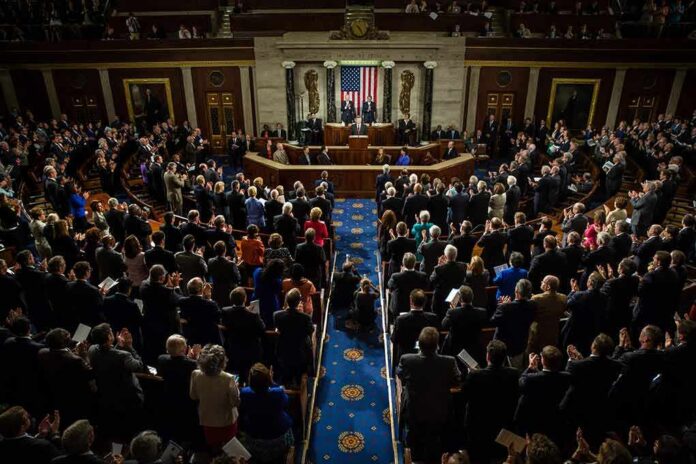
The fight over whether prosecutors may quietly obtain lawmakers’ phone and text records in a criminal probe is not a social-media gotcha; it is a constitutional stress test that forces three powerful commitments to collide at once: Congress’s Speech or Debate protections, the Justice Department’s duty to follow the evidence, and the public’s expectation that even high office confers no immunity from investigation.
At a Glance
- Republican senators allege that Jack Smith’s team secretly obtained toll and text records from dozens of lawmakers during the Trump investigations; committee materials assert communications from 44 members were accessed.
- Smith does not dispute seeking congressional toll records; he says they were relevant to the Trump inquiry and pursued under DOJ policy and court orders, denying any Speech or Debate Clause violation.
- The sharpest charge—lying under oath about congressional texts—remains an allegation, not an adjudicated finding; Smith publicly rejects claims of political motive and defends the legality and necessity of the steps taken.
- The core question is not whether authority exists to subpoena third-party records, but how prosecutors cabin that power against legislative privilege and election-year sensitivities.
What prosecutors obtained, and why it matters
According to the Senate Judiciary Committee’s Republican release, the special counsel’s team “secretly obtained text messages from 44 Members of Congress” in the course of the Trump investigations, a claim that electrified the hearing because it moves beyond familiar toll-record subpoenas into content-adjacent terrain and raises immediate privilege and separation-of-powers alarms. Separate reporting and on-record testimony also indicate the office sought toll or call records for Republican senators and other lawmakers whose communications were potentially probative of efforts to contest certification on January 6—steps Smith framed as fact-gathering about Trump’s conduct, not an inquiry into legislators themselves. For prosecutors, that distinction matters: tools aimed at non-privileged third-party metadata are common in complex cases; tools that pierce privileged legislative activity are constitutionally fraught.
Smith’s defense was blunt: decisions were “based on the facts and the law,” not party alignment; he insisted he would have made the same calls were the target a Democrat, and denied violating the Speech or Debate Clause, which shields “legislative acts” from executive or judicial interference. He also stated his office followed Department policy and obtained judicial authorization for non-disclosure orders when necessary—standard practice to prevent tipping off witnesses or destroying evidence. Critics counter that “standard” is not the point when the recipients are coequal-branch officials; process that is unremarkable for private actors can be constitutionally loaded when applied to Congress.
Where the hard legal line actually runs
The Speech or Debate Clause is not a blanket immunity for lawmakers’ lives; it protects legislative acts and their preparation. Courts draw a textured boundary: core legislative work-product, internal deliberations, and floor or committee activity are absolutely protected; personal, political, and campaign communications are not. In practice, that boundary is enforced through ex ante narrowing (what the subpoena actually seeks), minimization and privilege filtering (what is reviewed and by whom), and, where appropriate, notice that allows the institution to assert privilege before production. Smith told senators his office sought to comply; Republicans argued the approach inverted the order—obtain first, filter later—and, worse, sometimes masked the congressional nature of the records in sealed applications, short-circuiting privilege assertion. If accurate, that practice is defensible only if the requests were limited to non-privileged material and if a robust privilege filter prevented exposure to protected content. Those are document-driven questions; until sealed applications and filter protocols are public, both narratives remain plausible.
There is also a category difference between toll records and content. Toll records—who called whom, when, for how long—are not protected by the Fourth Amendment in the same way as content and, standing alone, rarely implicate Speech or Debate unless used to infer legislative deliberations. Content or near-content (for example, message bodies or attachments recovered via a cooperating custodian) is more sensitive. The committee’s “44 members’ texts” claim, if borne out, would heighten the constitutional stakes, not just the optics.
The perjury and “political targeting” claims, weighed
Two accusations dominated the hearing theater: that Smith lied under oath to Congress about whether his office obtained lawmakers’ texts, and that the entire enterprise was engineered to damage a political opponent by timing indictments close to the 2024 election. On the first, we are in allegation territory. Senators pressed supposed inconsistencies between prior testimony and later document revelations; as of this writing, no court or disciplinary body has found that Smith knowingly made a false material statement. The charge is serious; the evidentiary posture is not yet dispositive. An honest reading keeps both points in view.
On political motive, Smith’s position is consistent across venues: he is not a politician, harbors no partisan loyalties, and brought charges because the investigation developed proof beyond a reasonable doubt of serious crimes; he says the same decisions would follow regardless of party. Republicans cite an internal DOJ Public Integrity caution against late-campaign filings and argue Smith pressed forward anyway—evidence, in their telling, of bias rather than judgment. The existence of policy cautions is undisputed; whether proceeding in the face of them evidences partisanship or a good-faith prosecution calculus is the crux of the disagreement, and not one that can be resolved without the full advisory record.
How we got here: extraordinary facts, elastic tools
The modern investigative playbook—grand jury subpoenas to telecoms, sealed non-disclosure orders, quick-turn filter teams—was built for sprawling conspiracies with diffuse actors. January 6 and the post-election period created exactly that vector, but with a twist: the communications web did not stop at campaign aides; it ran through the legislature’s own leadership. When prosecutors followed those trails, the ordinary tools met extraordinary targets. That is why the same fact pattern reads as overreach to one audience and as necessary diligence to another. It is also why process design matters more here than usual; even a lawful step can become a constitutional problem if executed without the right privilege scaffolding.
One reason the dispute persists is structural opacity. Much of what would settle it—sealed applications, minimization protocols, privilege logs, and the chain-of-custody for any messages that touched congressional accounts—lives behind court orders. Prosecutors cannot unilaterally publish them; committees can summarize selectively; the public is left adjudicating competing narratives with partial records. In that vacuum, partisanship does the explaining work.
What credible oversight looks like
Substance beats spectacle. Three transparency moves would illuminate more than another viral hallway confrontation ever could. First, release, with necessary redactions, the docketed materials for any subpoena that touched a congressional account, including the government’s privilege representations and the court’s findings. Second, disclose the privilege-review architecture: who filtered, what keywords and date ranges were used, how segregated material was walled off, and whether Congress or telecom custodians were allowed to assert privilege before any review. Third, publish the internal election-sensitivity advisories surrounding indictment timing alongside the special counsel’s written response. Each step respects ongoing cases while letting citizens see whether the machinery honored the Constitution’s limits.
The broader precedent question is not whether prosecutors can pursue facts that implicate lawmakers—they can, and sometimes must—but whether the executive branch can do so with procedures that give the legislative branch a genuine, timely opportunity to protect its institutional prerogatives. That is where the line of legitimacy will be drawn, long after the personalities have rotated out of frame.
The bottom line
Strip away the theatrics and two propositions remain sound. One, the government has authority—backed by courts—to obtain non-privileged third-party records relevant to a criminal case, even when they involve powerful people. Two, when the target set includes sitting lawmakers, that authority must be exercised with uncommon care: narrow scopes, forthright representations to judges, privilege filters that work in practice, and transparency that survives partisan crossfire. The hearing record shows legitimate procedural questions worthy of sunlight and a prosecutor who insists, with equal force, that his team stayed within the law. The country is best served by testing those claims against documents, not applause lines.
Sources:
pbs.org, judiciary.senate.gov, nytimes.com