

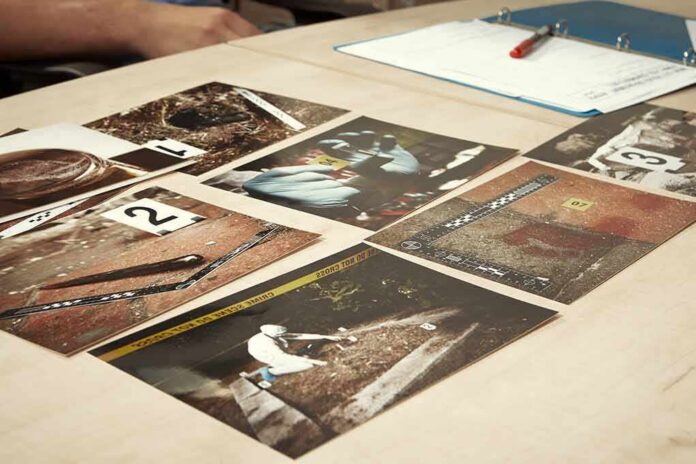
In intimate-partner homicide trials without a recovered weapon or eyewitness, the case is won or lost on whether the surrounding facts cohere; when they do, circumstantial evidence is not a consolation prize but the backbone of proof.
At a Glance
- Prosecutors anchored their case in a vast digital record: more than 100,000 messages, device activity, and interview tapes that they argue show motive, planning, and post-crime concealment.
- The “intruder” account is undercut by scene findings: no credible forced entry, a sleeping victim, and a missing handgun Flynn said he kept in his truck.
- Affair-related communications include explicit violent sentiments; jurors heard phrases like “that makes two of us” in response to a wish that Ashley die.
- The defense leans on the absence of the gun and challenges to device data, arguing the state’s narrative is motive-heavy and proof-light.
What the Evidence Says When There Is No Gun
Homicide prosecutions frequently proceed without a recovered firearm; courts have long held that circumstantial evidence can be as probative as direct evidence when the pieces fit together. The doctrinal point isn’t academic — jurors must decide whether motive, opportunity, scene reconstruction, and a defendant’s own words converge into the only reasonable account of what happened. In the Flynn case, prosecutors built exactly that kind of lattice: a marriage on the brink, an affair featuring violent dialogue, a staged-intruder narrative they say collapses under physical inspection, and a weapon that vanished from the one place the defendant claimed to keep it. This is the architecture of a circumstantial case done in sequence, not a morality tale grafted onto thin facts.
The digital record dominates. Prosecutors introduced an enormous corpus — roughly 107,000 exchanged messages — to situate motive and intent across a year and a half, including exchanges in which Flynn and Alleigha Botner spoke about Ashley’s death in language the state characterizes as literal rather than venting. Jurors heard the prosecution’s exemplars; Botner’s “I want to kill her, Caleb,” met by Flynn’s “that makes two of us,” is the kind of unguarded candor that prosecutors argue jurors should read at face value when viewed against the subsequent timeline.
The Alleged Intruder Versus the Physical Scene
The state’s rejection of the intruder theory rises or falls on the scene mechanics. Investigators reported no credible signs of forced entry, described the side door as unlatched or damaged in a way inconsistent with a real break-in, and detailed a bedroom that read as a close-range shooting of a sleeping victim — not the debris field of a struggle with a prowler. The defense counters that the absence of obvious tool marks or wide disturbance does not preclude a stealth entry, and that police focused on Flynn prematurely. But the prosecution’s point is narrower and sturdier: if you posit an intruder, you must supply a pathway and behavior that match the physical record. Jurors do not need the state to disprove every theoretical outsider; they need a coherent account of this outsider in this house that night. The state argues they have not seen one.
Compounding the scene logic is the missing gun. Flynn told police he kept a handgun in his truck’s center console; officers said that console was found open and empty. The weapon used to kill Ashley has not been recovered — a reality the defense leans on — but in the state’s telling, disappearance in that context fits concealment far better than it does an intruder who slips in and out of a family home, bypasses valuables, and somehow departs with the homeowner’s firearm after a targeted bedroom killing.
What the Messages and Devices Contribute — and What They Don’t
Device data and digital communications do three distinct jobs here. First, they illuminate motive: a long affair set against marital deterioration, with messages that escalate from resentment to explicit violent ideation. Second, they offer timing clues: phone and watch activity, audio routing changes, and app deletions bracketing the window between a couple going to bed and a 2:30 a.m. 911 call. Third, they map concealment behavior — deletions, resets, and coordination to sanitize accounts — which tends to corroborate consciousness of guilt when it clusters around the critical window.
The defense presses two vulnerabilities. Botner initially lied to investigators about the affair — a live credibility fault — and the reliability of consumer device telemetry is not absolute. Jurors in other cases have still accepted wearable and phone data when the collection method and error margins are competently explained; courts have admitted such streams where foundations are laid and the testimony is methodologically sound. The rule of thumb is simple: these artifacts rarely prove “who pulled the trigger,” but they can decisively bracket “who was awake, moving, deleting, or messaging” when the house should have been still. In that light, even modestly reliable timelines can matter a great deal.
Motive Is Not a Verdict, But It Is a Load-Bearing Beam
Reasonable-doubt arguments often caricature motive as gossip dressed up for court. That is not how the law treats it. In intimate-partner murders, motive evidence — jealousy, infidelity, financial and reputational stressors — frequently carries legitimate inferential weight, particularly when paired with opportunity and post-crime behavior. Appellate opinions repeatedly affirm verdicts built on such mosaics when the aggregate record is “most compelling, if not irresistible” despite the absence of direct proof. The relevant question is not whether the affair makes Flynn “unlikeable,” but whether the documented hostility, articulated plans, and synchronized deletions move the case from suspicion to inference sufficiently strong to convict. Comparative case law and scholarship say that is often where circumstantial cases are properly decided.
The defense insists the prosecution’s reliance on motive reveals weakness. That can be true when motive stands alone. It does not when motive is braided to physical-scene contradictions, a missing weapon from the defendant’s own inventory, and a communications record that reads like prelude followed by denouement. In those circumstances, motive is not a distraction; it is a structural element that explains why the other bricks sit where they do.
‘I didn’t touch my wife’: Former ‘American Idol’ star Caleb Flynn told cops he didn’t murder Ashley Flynn in tape played to jury at Ohio trial https://t.co/NTENAtYMuS
— Knewz (@knowknewz) September 29, 2026
Why Staged-Home-Invasion Narratives Are Common — and Often Fail
Professionals who study staged crimes define staging as deliberate alteration meant to redirect suspicion away from the most logical suspect. In domestic homicides with female victims found at home, red flags include a discovery by the intimate partner, selective disorder inconsistent with theft, and a narrative that solves for the defendant’s innocence but not for a real outsider’s behavior. The literature is clear: staging is not rare, and its telltales are recognizable once you look for congruence between claim and scene. When the alleged break-in routes, damage patterns, and victim posture cannot be squared with standard burglary or assault dynamics, jurors are justified in treating “intruder” as a story rather than a hypothesis.
Where the Real Dispute Lives
Strip away the headlines and the case reduces to three disputes. First, are the violent-ideation messages literal enough, in context, to signal intent rather than fantasy? Second, do the scene facts and missing gun push the intruder account past plausibility into pretext? Third, are the device-derived timelines sufficiently reliable to narrow the murder window and link it to Flynn’s conduct? The defense’s broad critiques — missing gun, no eyewitness, and device skepticism — are classic, and they matter. But prosecutors don’t have to produce a perfect digital chronicle to meet their burden; they must offer a logically consistent narrative in which the digital, physical, and human evidence point the same direction. On this record, the state’s theory is cohesive and the counter-theory is diffuse. The weight of specific, named facts favors the former.
How to Read This Case Without the Tabloid Frame
The celebrity-adjacent gloss — “American Idol” alum, pastor, salacious texts — tempts readers to treat the trial as cultural theater. Resist that. The right lens is the sober law of circumstantial proof: when motive aligns with opportunity, when a defendant’s own words and actions sit in sequence around the act, and when the alternative stories don’t fit the physical world, juries are entitled to convict. That is not sensationalism; it is how homicide is proven when no one alive saw the trigger pulled. In that sense, this case is less an outlier than a case study in how modern prosecutions braid digital trails to scene science and human testimony to answer the only question that matters: what really happened in that room.
Sources:
youtube.com, cnn.com, abc7chicago.com, abcnews4.com, nypost.com