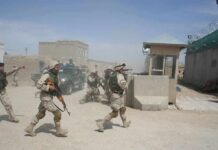


A tenuous ceasefire shattered in early March 2026 when Hezbollah fired missiles at Haifa, unleashing over 250 Israeli airstrikes and displacing 800,000 Lebanese civilians as both sides prepare for a ground war that could reshape the Middle East.
Story Snapshot
- Hezbollah launched six missiles at Haifa on March 1, 2026, breaking months of restraint following the assassination of Iran’s Supreme Leader Ali Khamenei
- Israel issued mass evacuation orders for up to 800,000 people across southern Lebanon and Beirut while conducting over 250 airstrikes on Hezbollah infrastructure
- The IDF prepares a ground invasion with three divisions to establish a buffer zone south of the Litani River amid ongoing clashes in fortified villages
- Lebanese President Joseph Aoun accuses Hezbollah of dragging the country into Iranian-driven chaos that risks complete state collapse
- Hezbollah regroups in southern Lebanon’s eastern sector despite Lebanese government claims of full disarmament in January 2026
The Fragile Ceasefire Collapses
The November 2024 ceasefire ended 66 days of brutal fighting between Israel and Hezbollah, but it never truly held. Throughout February 2026, Israeli drones and mortar strikes methodically eliminated Hezbollah operatives attempting to restore military infrastructure in villages like Yanouh, Ayta Ash Shaab, and Tiri. The militant group had quietly rearmed south of the Litani River despite Lebanese officials announcing complete disarmament on January 8. When the U.S. and Israel assassinated Iran’s Supreme Leader Ali Khamenei, Hezbollah abandoned all pretense of restraint. The March 1 missile barrage targeting Haifa marked not just retaliation but a calculated shift to open warfare.
Mass Displacement and Humanitarian Crisis
Israel’s response transformed southern Lebanon into an evacuation zone within days. On March 4, the IDF ordered residents north of the Litani River to flee as Israeli forces clashed with Hezbollah fighters near Khiyam and Ed Dhayra. The following day, another evacuation order targeted 500,000 people in southern Beirut ahead of systematic bombing campaigns against Hezbollah’s financial networks. Chaos erupted as families packed vehicles and fled north, creating traffic nightmares and overwhelming host communities. More than 600,000 Lebanese civilians found themselves displaced, joining hundreds already killed in the renewed hostilities. Northern Israeli communities faced their own exodus as Hezbollah rockets threatened civilian areas.
Guerrilla Warfare in Fortified Villages
Hezbollah’s strategy relies on decades of preparation in southern Lebanon’s rugged terrain. The group fortified villages throughout the eastern sector, particularly around Khiyam and Mount Dov, creating defensive positions designed for exactly this scenario. Unlike conventional armies, Hezbollah fighters blend into civilian areas and use intimate knowledge of local geography to mount ambushes and slow Israeli advances. ACLED analysts studying the conflict predict sustained clashes resembling previous Israeli incursions, where each village becomes a battleground. The IDF counters with overwhelming airpower, targeting what it calls military and financial infrastructure, though the distinction grows murky when strikes level entire neighborhoods.
The Buffer Zone Strategy and Regional Stakes
Israeli Prime Minister Benjamin Netanyahu and Defense Minister Israel Katz explicitly outlined their objective: establish a permanent buffer zone south of the Litani River to protect northern Israeli communities. The IDF’s 91st, 210th, and 146th Divisions stand ready for a ground invasion Netanyahu promises will commence within weeks. This represents far more than limited incursions Israel conducted previously. A full-scale occupation of southern Lebanon would dramatically expand the conflict, potentially drawing Iran deeper into direct confrontation. Lebanese President Aoun desperately proposed international assistance for disarmament and direct negotiations with Israel, recognizing his government lacks the power to forcibly disarm Hezbollah without civil war.
Lebanon’s Impossible Position
The Lebanese state finds itself trapped between Israeli military might and Hezbollah’s entrenched power. Prime Minister Nawaf Salam received a mandate after the 2024 fighting to disarm Hezbollah, but the group answers to Tehran, not Beirut. Aoun’s accusations that Hezbollah drags Lebanon into Iranian proxy conflicts ring true, yet his government commands insufficient military strength to challenge the militants. The November ceasefire required Lebanese forces to assert control south of the Litani, but Hezbollah never truly withdrew. This fundamental weakness explains why Israel dismisses Lebanese government assurances and prepares unilateral military action. The economic toll compounds political paralysis as bombing campaigns destroy infrastructure Lebanon cannot afford to rebuild.
The coming weeks will determine whether this escalation spirals into full regional war or finds an off-ramp through diplomatic intervention. Israel’s determination to create a buffer zone collides with Hezbollah’s refusal to abandon southern positions and Iran’s strategic interest in maintaining its Lebanese proxy. Lebanese civilians pay the highest price, displaced en masse while their government proves powerless to protect them. The assassination of Iran’s supreme leader removed whatever restraints previously moderated Hezbollah’s response to Israeli provocations. Both sides now prepare for sustained ground combat that could dwarf the 2006 war in destruction and casualties, with neither showing willingness to back down.
Sources:
Israel Prepares Ground Invasion Lebanon Hezbollah Formally Joins War – ACLED
Israeli Operations in Lebanon Against Hezbollah February 9-15 2026 – FDD
Younes Shakir Israel Lebanon War Strikes – Democracy Now