

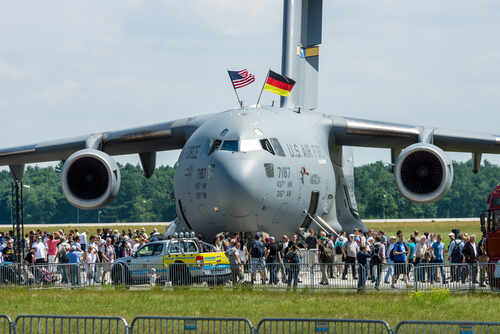
Rare U.S. Air Force C-17 cargo jets touching down in Beijing is the quiet, unmistakable sign that a high-stakes Trump–Xi summit is moving from rumor to reality.
Quick Take
- Multiple C-17 Globemaster III flights were spotted arriving at Beijing Capital International Airport ahead of a planned May 14–15 Trump–Xi meeting.
- The airlift reportedly delivered vehicles and security-related equipment, a typical requirement for presidential travel and protective operations.
- The summit was previously expected earlier in 2026 but appears to have been delayed amid fallout from the prolonged Iran war.
- There has been no official public confirmation from Washington or Beijing, so much of the reporting relies on observed aircraft movements and media sourcing.
C-17 arrivals in Beijing signal a summit that’s hard to fake
U.S. Air Force C-17 Globemaster III cargo aircraft were reported landing at Beijing Capital International Airport in early May, including a flight observed May 1 identified by tail/serial details in public reporting. The shipments were described as bringing vehicles, advanced materials, and security equipment to prepare for President Donald Trump’s expected visit and meetings with Chinese leader Xi Jinping on May 14–15. That kind of logistics footprint is unusual in Beijing and difficult to explain away as routine.
The key limitation is verification: neither government has issued a definitive public statement confirming the cargo, the number of flights, or the final summit schedule. Still, large-scale airlift into a foreign capital is not a symbolic gesture—it is a practical step tied to security and mobility needs. When these flights happen, it generally means planners on both sides expect the meeting to occur, regardless of how carefully the politics are managed in public.
Why this looks familiar: the 2017 precedent and protective logistics
Reports emphasized that similar C-17 activity preceded Trump’s 2017 trip to China, reinforcing the idea that what’s happening now is part of a known playbook. Modern presidential travel often requires armored vehicles, specialized communications gear, and secure support equipment that cannot be trusted to commercial channels. From a conservative “government competence” standpoint, this is one area where the state’s basic job—protecting national leaders abroad—demands planning that is visible even when diplomacy stays officially quiet.
That “rare sight” aspect matters politically because it suggests Beijing is willing to accommodate U.S. military logistics on its turf, at least to the extent required for the visit. For Americans tired of empty press conferences and endless process, the aircraft movements are a more tangible signal than talking points. They show both capitals are preparing for a controlled, high-security encounter at a moment when U.S.–China rivalry has been the defining strategic tension of the decade.
Iran war delays and the pressure to stabilize major-power risk
Timing is central to the story: the meeting was widely expected earlier—late March or early April—but was reportedly pushed back as the Iran war dragged on, consuming attention and complicating diplomatic calendars. When major conflicts linger, they amplify global energy risk, supply-chain uncertainty, and defense posture decisions. Even voters focused primarily on costs at home feel those effects through inflation sensitivity, fuel price volatility, and the broader sense that foreign crises routinely spill into household budgets.
Markets, prediction odds, and the “elite reality” many voters resent
Some coverage pointed to prediction markets pricing high odds that the Trump China visit would occur within a certain time window, interpreting the C-17 arrivals as confirmation that planning is real. This is not proof of policy outcomes, but it is a snapshot of how finance and media ecosystems quickly convert geopolitics into tradable probabilities. For many Americans—right and left—that reinforces a familiar frustration: well-connected circles can often “see” government moves forming long before the public gets straight answers.
Conservatives who want limited government and clear accountability may view the secrecy as a double-edged sword. Operational security is legitimate, but democratic trust erodes when citizens learn about consequential diplomacy through aircraft spotters and market chatter instead of transparent institutions. At minimum, the episode underlines how much governing now happens behind layers of bureaucracy and messaging discipline—fueling the perception of a distant “deep state” culture, even when the underlying action is standard protective preparation.
What to watch next as May 14–15 approaches
The most concrete near-term indicator is whether airlift activity continues and whether either side issues even narrow confirmations such as travel windows, delegation size, or meeting agenda. Reporting has framed the summit as the first Trump–Xi meeting since an October 2025 encounter in South Korea, adding stakes for trade friction, security flashpoints, and the post-Iran-war strategic map. Until official readouts emerge, the C-17 landings remain the clearest observable evidence that a major diplomatic event is being staged.
For Americans skeptical of Washington’s priorities, the larger question is not whether the planes landed, but what any summit delivers: reduced risk of escalation, clearer trade terms, or measurable benefits that reach beyond insiders. The logistics suggest seriousness; the public still deserves clarity on objectives and results. In a political era defined by mistrust and exhaustion, visible actions like these flights raise expectations that leaders will do more than pose for photos—and actually defend U.S. interests without creating new costs at home.
Sources:
US Air Force cargo planes land in Beijing ahead of Trump-Xi summit
US C-17 lands in Beijing signaling preparations for Trump’s China visit in May