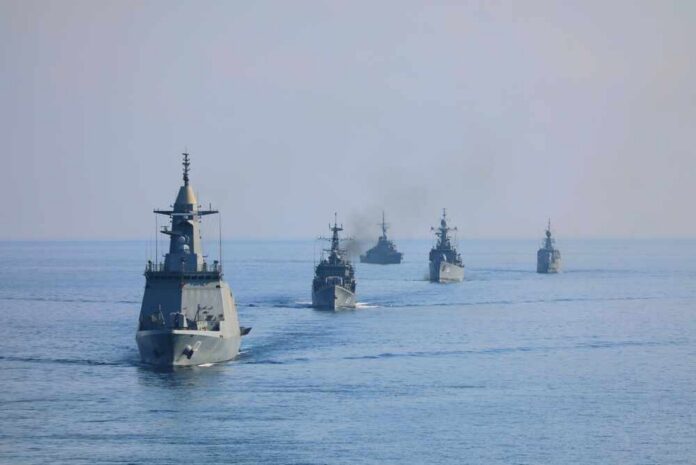
Two U.S. Navy destroyers ran a gauntlet of Iranian missiles, drones, and attack boats to enter the Persian Gulf, emerging unscathed in a high-stakes test of American resolve that Tehran claims never happened.
Story Snapshot
- USS Truxtun and USS Mason repelled coordinated Iranian attacks featuring cruise missiles, drones, and small boats without sustaining damage
- U.S. forces destroyed at least six Iranian attack boats during the transit under President Trump’s Project Freedom initiative
- Iran denies its boats were destroyed and claims no commercial vessels crossed despite U.S. confirmation of two successful transits
- The confrontation occurred in the Strait of Hormuz, a narrow waterway through which one-third of global seaborne oil passes
High-Stakes Passage Through Critical Chokepoint
The USS Truxtun and USS Mason entered the Strait of Hormuz on Monday as part of Project Freedom, the Trump administration’s initiative to reopen commercial shipping through the strategically vital waterway. The guided-missile destroyers faced sustained Iranian aggression involving multiple attack vectors including small boats, cruise missiles, and unmanned aerial vehicles. U.S. Central Command confirmed that defensive systems intercepted or defeated every incoming threat through what Admiral Brad Cooper described as the “clinical application of defensive munitions.” Neither destroyer sustained damage, and no American personnel were injured during the passage through waters as narrow as three miles in some sections.
Coordinated Iranian Response Neutralized
Iranian forces launched a multi-pronged assault attempting to block the destroyers’ passage into the Persian Gulf. U.S. forces destroyed at least six Iranian small boats during the engagement, with Apache and MH-60 Sea Hawk helicopters providing air support alongside the destroyers’ integrated defensive systems. The coordinated nature of the Iranian attack—combining surface vessels, missiles, and drones—represented a deliberate effort to deny American warships access to international waters. Despite the intensity of the barrage, no projectiles reached the American vessels, demonstrating either the superiority of U.S. naval defensive technology or Iranian reluctance to escalate beyond harassment tactics.
Competing Narratives Over Who Controls the Strait
Stark contradictions exist between American and Iranian accounts of the engagement. While U.S. officials confirm the destruction of Iranian boats and the successful transit of two commercial vessels under military protection, Iranian state media denies any boats were destroyed and claims no commercial shipping has crossed the strait recently. This information warfare reflects both sides’ attempts to establish narratives of control over the waterway. U.S. Treasury Secretary Scott Bessent insisted America maintains full control over the strait, directly contradicting Iranian media claims that the waterway is closed except to vessels with explicit Iranian military permission. The competing claims leave the international community—and particularly shipping companies—uncertain about the actual security situation in waters carrying one-third of global seaborne oil trade.
Strategic Implications for Global Commerce
The successful transit represents more than a tactical military victory; it tests whether the United States can credibly guarantee freedom of navigation through a chokepoint vital to global energy markets and international commerce. Project Freedom’s viability depends on demonstrating that American military protection can ensure safe passage for commercial vessels despite Iranian opposition. Oil-importing nations worldwide depend on stable transit through the Strait of Hormuz for energy security, while shipping companies face escalating insurance premiums and operational costs due to the heightened risk environment. The transit occurred as a fragile ceasefire neared expiration, suggesting the agreement’s limited effectiveness. For Americans frustrated with endless Middle Eastern entanglements, the question remains whether protecting commercial shipping justifies the risk of broader conflict—or whether the government is once again prioritizing global interests over domestic concerns while ordinary citizens struggle with inflation and economic insecurity at home.
Sources:
Iran threatens American ships if they enter Hormuz as US kicks off Project Freedom – Times of Israel
2 U.S. Navy destroyers transit Strait of Hormuz after dodging Iranian onslaught – CBS News
Iran war: Trump Strait of Hormuz ship attack threat, peace proposal – CBS News Live Updates
2026 United States naval blockade of Iran – Wikipedia