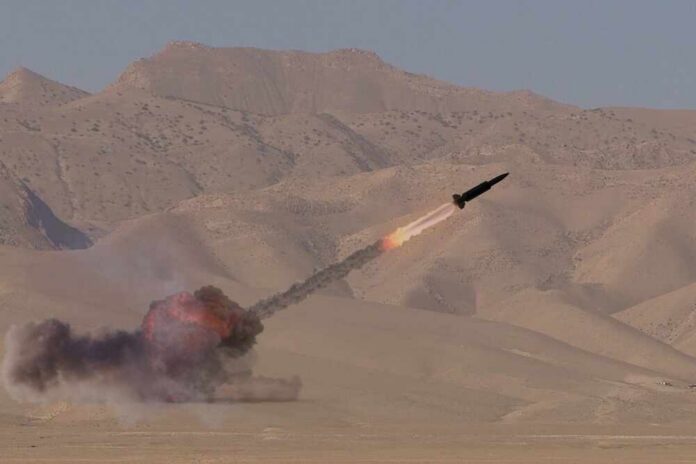
Iran’s drone and missile network took a direct hit from U.S. precision strikes after an American aircraft was shot down and Gulf partners came under fire—raising sharp questions about deterrence, self-defense, and what comes next.
Story Snapshot
- U.S. Central Command says strikes targeted Iranian radar and drone control sites tied to threats in the Strait of Hormuz [2].
- The action followed Iran’s shootdown of a U.S. drone over international waters, according to public statements [1][2].
- Commanders described the operation as measured, limited, and aimed at maritime security; no U.S. casualties were reported [1][2].
- Reporting highlights an “ongoing ceasefire” backdrop, fueling debate over imminence and escalation [2][3].
What CENTCOM Says Was Hit and Why It Matters
U.S. Central Command reported destroying radar and drone command-and-control facilities in Goruk and on Qeshm Island, plus an air-defense site, a ground control station, and two one-way attack drones assessed as clear threats to vessels in the Strait of Hormuz [1][2]. Commanders framed the mission as protecting regional maritime traffic after repeated Iranian actions against civilian and commercial shipping lanes. Officials stressed the intent was to neutralize specific military nodes rather than broad infrastructure, emphasizing precision and proportionality [2].
CENTCOM tied the operation to the prior downing of a U.S. unmanned aircraft operating over international waters, calling the strikes a necessary, defensive response to ongoing Iranian aggression [1][2]. Outlets covering the command’s statements reported no U.S. casualties from the operation and characterized it as deliberate and limited in scope [1][2]. The self-defense framing underscores Washington’s effort to deter further attacks without opening a broader campaign, while signaling that threats to sea lanes and American assets will draw immediate consequences [2].
Ceasefire Context and Escalation Concerns
Coverage of CENTCOM’s announcement repeatedly referenced an “ongoing ceasefire,” a context that inevitably invites scrutiny over the timing and imminence standards for self-defense in international law [2][3]. Analysts and anchors highlighted that strikes occurred inside Iran, not merely as intercepts of inbound munitions, fueling arguments that the action could be seen as an escalation even if tailored [3]. The public record so far rests on statements and broadcast summaries, which shape early perceptions before underlying legal and targeting documents surface [2][3].
Reporters also noted a broader cycle of reciprocal actions, with claims of Iranian missile and drone activity against Kuwait and Bahrain imposing pressure on partners and shipping [3][5]. This pattern reinforces how quickly maritime and airspace incidents can spiral, especially when platforms like short-form video amplify headlines such as “self-defense strikes” that can harden narratives before full evidence is reviewed [3]. The risk is a feedback loop: necessary deterrence can be portrayed as escalation, while delayed disclosure fuels speculation on both sides [2][3][5].
What We Know, What We Don’t, and Why Accountability Matters
Public information confirms CENTCOM’s target set, the stated link to maritime security, and the absence of U.S. casualties [1][2]. It does not yet include the operational order, battle damage assessments, rules of engagement, or the legal memo underpinning proportionality and necessity claims [1][2]. The available material also does not provide the sensor logs or debris analysis proving the exact conditions of the initial drone shootdown, or independent air-defense records from Gulf partners validating timelines for Iranian launches [1][2][3].
"Escalation continues."
CENTCOM hitting Qeshm Island in self-defense after Iran attacked civilian vessels and launched missiles/drones toward Kuwait and Bahrain. Good that most of the incoming threats were defeated, but this back-and-forth is getting dangerous fast.
Iran keeps…
— GOOD GOVERNANCES (@eaglerepublics) June 3, 2026
For readers focused on national strength and constitutional accountability, two truths can coexist. First, protecting American forces, global shipping, and allied civilians demands swift, decisive action when hostile actors endanger sea lanes and shoot down U.S. aircraft. Second, Congress and the public deserve clarity on the legal and operational basis for force, especially when strikes hit inside a sovereign state amid a claimed ceasefire. Releasing unclassified summaries, battle damage assessments, and legal notifications would strengthen deterrence by anchoring it in documented legitimacy [2][3].
The Conservative Bottom Line: Peace Through Strength, Backed by Proof
Deterrence works when adversaries believe America will act—and when allies see that action grounded in law, precision, and restraint. CENTCOM’s targeted hits on Iran’s drone and radar network send a necessary message after attacks on shipping and the downing of a U.S. aircraft [1][2][3]. To prevent mission creep and silence bad-faith spin, the administration should expedite declassified evidence on the threat timeline, the drone incident location, and collateral risk mitigation. Strength plus transparency protects our sailors, our economy, and our credibility [2][3].
Sources:
[1] Web – US carries out ‘self-defense’ strikes against Iranian drones and …
[2] Web – US strikes Iranian drone facilities in ‘self-defense’ operation
[3] Web – US launches ‘self-defense’ strikes against Iran amid stalled …
[5] YouTube – US says it carried out ‘self-defense’ strikes against Iran over …