
An Iranian-flagged cargo ship learned the hard way that the U.S. Navy’s blockade orders aren’t suggestions.
Story Snapshot
- USS Spruance intercepted the Iranian-flagged cargo ship Touska in the Gulf of Oman after it attempted to bypass a U.S. blockade of Iranian ports.
- U.S. forces issued warnings, then fired disabling shots into the ship’s engine room before Marines boarded and took custody, according to President Trump and U.S. military reporting.
- The ship is reported to be under U.S. Treasury sanctions for prior illegal activity, and its cargo is now under inspection.
- The seizure marks a sharper turn in the maritime standoff as the ceasefire window narrows and both sides dispute who controls access around the Strait of Hormuz.
What happened in the Gulf of Oman—and why it matters
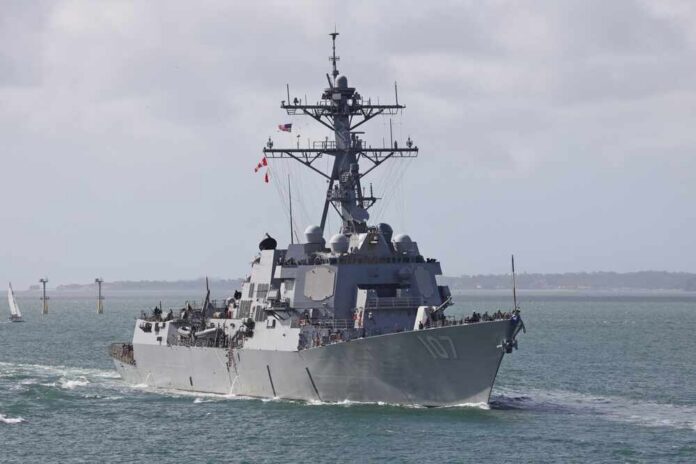
U.S. forces intercepted the Iranian-flagged cargo ship Touska early Sunday after it tried to push past a U.S. naval blockade near the Strait of Hormuz entrance. Reports say the crew ignored multiple warnings to stop, prompting USS Spruance to fire into the engine room to disable the vessel. U.S. Marines then boarded and took “full custody,” with the cargo held for inspection under sanctions enforcement.
U.S. Central Command has also described a broader campaign of non-violent interceptions in the same area, with roughly two dozen ships turned away before this incident. That contrast is what makes this seizure different: it appears to be the first reported case in the current blockade where U.S. forces fired on and boarded an Iranian vessel. The ship’s name appears with minor spelling variations across reports, but the core sequence is consistent.
The blockade, the ceasefire clock, and mixed signals from Tehran
The seizure lands in the middle of a high-stakes, fast-moving dispute over whether the Strait of Hormuz is “open,” “closed,” or simply functionally constrained by U.S. naval power. Iran publicly shifted positions in recent days, with one announcement that commercial traffic could pass and a later reversal ordering closure. U.S. statements emphasize the blockade of Iranian ports and access points rather than a formal declaration shutting the entire strait.
The timing matters because the current ceasefire period is nearing its end, raising the risk that small tactical events can trigger large strategic consequences. Trump has tied the blockade directly to leverage for a “permanent deal,” and he has publicly warned of further escalation if Tehran does not agree. Iranian officials have countered that restrictions will remain until the U.S. lifts the pressure campaign, leaving both sides testing limits at sea.
Enforcing sanctions at sea: deterrence versus escalation risk
Sanctions enforcement is one of the key lenses for understanding why a cargo ship becomes a front-page story. The vessel is reported to be under U.S. Treasury sanctions for prior illegal activity, which makes interdiction more than a symbolic checkpoint. In practical terms, stopping a sanctioned ship is meant to choke off cash and materiel that could sustain Iran’s posture in the conflict, even as negotiators explore off-ramps.
That said, firing disabling shots and conducting a boarding operation is inherently escalatory compared with simply turning ships around. U.S. commanders must weigh deterrence and maritime security against the risk of retaliation against U.S. assets or commercial shipping. The administration is betting that visible enforcement reduces future attempts to run the blockade, but the next Iranian response will largely determine whether this becomes a one-off message—or the new pattern.
The domestic political subtext Americans can’t ignore
At home, this incident will reinforce a familiar split-screen reality: many conservatives see a needed show of strength after years of mixed messaging abroad, while many liberals view the same action as a step toward deeper conflict. What’s broadly shared, across left and right, is the fatigue with institutions that feel reactive instead of strategic. In a high-cost era, voters want clear objectives, measurable outcomes, and an exit plan.
Iranian Cargo Ship Tries to Get Past the U.S. Blockade – Trump: It 'Did Not Go Well for Them' https://t.co/r8xEYbdjDr
— Ordnance Jay Packard Esq. (オードナンス・ジェイ・パッカード) (@OrdnancePackard) April 19, 2026
The administration’s next moves—inspections, legal handling of the ship, and the diplomacy that follows—will decide whether the seizure is remembered as disciplined enforcement or a spark that widens the fight. Limited public detail remains on the cargo contents and the precise legal process for disposition, so the most reliable takeaway for now is narrow but significant: Washington is demonstrating it will physically enforce its blockade, not just announce it.
Sources:
Live updates: Tehran vows retaliation after US seizes Iran-flagged vessel defying
US attacks and seizes Iranian cargo ship, as Iran says ‘no decision’ yet on joining
Iran strikes US vessels in retaliation for cargo ship’s seizure