

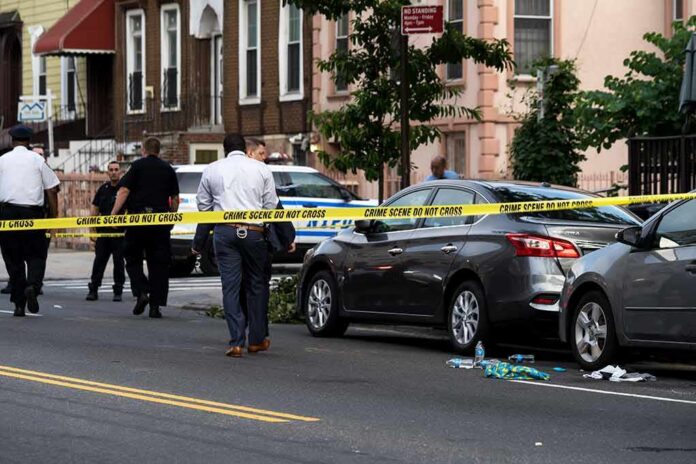
Large, multi-agency drug sweeps are not police theatrics; when they work, they map and strike the logistics of a narcotics network in one coordinated pulse. San Diego just saw a textbook version: four federal indictments, dozens of defendants, and warrants served across the county—an operation built to fracture a fentanyl–methamphetamine pipeline that investigators say ran from Mexico into neighborhood markets across Southern California.
At a Glance
- Federal grand juries returned four indictments charging 42 alleged gang members and associates tied to fentanyl and methamphetamine trafficking.
- At least 35 people were arrested as hundreds of officers executed 10 search warrants across San Diego County and beyond.
- Authorities identify John “Guero” Marquez of the Poway-based Varrio Hidden Hills gang as an alleged organizer; the group is described as affiliated with the Mexican Mafia.
- Agents seized drugs, firearms, ammunition, and cash during the two-year investigation and takedown.
What the operation did, and how
Federal and local teams executed a coordinated series of arrests and searches grounded in four federal indictments that collectively name 42 defendants for alleged drug-distribution, possession, and conspiracy offenses built around fentanyl and methamphetamine. Contemporary accounts describe a morning of synchronized entries that moved from Poway and Lemon Grove through National City, Chula Vista, El Cajon, Oceanside, Escondido, and up the I‑15 corridor into Riverside and Tulare counties—a geographic span consistent with a wholesale-to-retail distribution scheme rather than a single neighborhood crew. The arrest count reached at least 35 as warrants came down; hundreds of officers participated, and 10 search sites were cleared and processed for evidence.
Charges track the standard architecture of federal narcotics cases: conspiracy counts to capture the network’s connective tissue; distribution and possession counts for concrete deals; and enhancements tied to volumes and substances. Fentanyl and methamphetamine anchor the allegations—a familiar pairing in border districts—because the two drugs move through overlapping smuggling and local distribution channels while targeting distinct consumer markets with high repeat demand.
Alleged organizer, organizational ties, and on-the-ground risk
Investigators point to John Marquez, 49, known as “Guero,” as an alleged organizer and a documented member of the Poway-based Varrio Hidden Hills street gang. Authorities characterize Varrio Hidden Hills as affiliated with the Mexican Mafia, an attribution that, in practice, often signals taxation, protection, or directive relationships between street-level sellers and prison-based power centers rather than a rigid corporate hierarchy. The affiliation matters operationally: Mexican Mafia-linked networks historically exert control through communications that extend from custody to the street, creating durable channels for resupply, discipline, and revenue extraction.
The tactical risk to agents was real. During the Lemon Grove warrant service, someone inside a targeted residence reportedly fired through the front door; no agents were injured, and the entry team concluded its mission. Incidents like that underscore why agencies stage these actions with decisive mass—hitting multiple nodes forces suspects onto the back foot and limits time to destroy evidence, coordinate resistance, or flee.
What investigators say they seized—and why those categories matter
Across the two-year investigation and the takedown itself, authorities report recovering drugs, firearms, ammunition, and cash. Each category advances different prosecutorial levers. Narcotics establish the core offense conduct and—when supported by lab results and weight thresholds—drive mandatory-minimum exposure. Firearms and ammunition can trigger separate federal counts or sentencing enhancements, especially when paired with drug-trafficking predicates. Cash, ledgers, and packaging supply the economic record: who collected, who owed, and how often money changed hands. In aggregate, those items do more than shore up the case file; they reconstruct the business model in a way a jury can see and understand.
Why San Diego is a recurrent stage for fentanyl–meth sweeps
San Diego’s border infrastructure, volume of crossers, and adjacent cartel territories make it a national choke point for synthetic drugs. Federal data have repeatedly identified San Diego and Imperial counties as the highest-volume corridors for fentanyl seizures at ports of entry. In July 2026 alone, CBP’s San Diego Field Office reported seizing 8,359 pounds of narcotics—including roughly 554 pounds of fentanyl and more than 5,000 pounds of methamphetamine—across 144 smuggling attempts. Those numbers do not merely color the background; they shape the scale and design of enforcement. When the flow is that dense, agencies increasingly pursue organization-wide takedowns to interrupt supply lines rather than chase retail sellers one by one.
That strategy has been visible in a series of regional cases, including Homeland Security Task Force investigations that emphasized fentanyl networks with double-digit defendant pools and parallel state-federal participation. The logic is straightforward: if you can simultaneously remove brokers, stash-house custodians, transporters, and key retail managers, you impose a longer recovery time on the network than if you arrest one courier with a backpack and a phone.
Geography of the alleged pipeline
Reporting on the San Diego sweep describes a cross-border sourcing model with distribution radiating through San Diego County and into other California locales—Poway and Lemon Grove as operational anchors, with activity noted from Oceanside and Escondido down to National City and Chula Vista, and inland through Temecula, Murrieta, and Riverside to Tulare. That footprint matches a wholesaling pattern: obtain bulk shipments near the border, subdivide to mid-level managers positioned along freeway spines, and move weight to local sellers who convert volume into retail sales across multiple neighborhoods—small transactions aggregated into a steady revenue stream.
How to read the numbers—and their limits
The headline metrics—four indictments, 42 defendants, at least 35 arrests, 10 warrants—are meaningful because they signal sustained investigative work, grand jury buy-in, and logistical muscle on takedown day. They are not, on their own, a verdict. In federal practice, cases of this size evolve: fugitive arrests are added, charging instruments are superseded, pleas are entered, and a handful of defendants press to trial. The Justice Department’s description that agents seized drugs, guns, ammunition, and cash is categorical by design; as litigation proceeds, weights, serial numbers, lab results, photos, and chain-of-custody records enter the docket, moving the story from categories to specifics.
One count worth clarifying for readers following multiple outlets: arrest and fugitive tallies can vary across same-day reports because they are snapshots taken at different hours as teams clear locations. Here, principal accounts center around the 35-arrest figure; others reported 34 in custody and eight at large at the time of their cutoffs. The swing reflects timing, not a contradiction of the underlying operation.
FBI arrests 35 in San Diego County in Mexican Mafia sweep https://t.co/frukzGvElb
— Patti Dennis (@realPattiDennis) October 31, 2026
What it means going forward
In the near term, expect detention hearings, discovery production, and a visible push by prosecutors to keep alleged leaders in custody on danger-to-the-community grounds—an argument that gains force when firearms, fentanyl, and alleged gang affiliation converge. Defense teams will probe surveillance methods, warrant affidavits, and the precise evidentiary basis for any claimed Mexican Mafia tie, because organizational attributions can influence sentencing exposure and trial posture. Longer term, the public question is whether multi-node sweeps produce durable reductions in supply or simply force rapid reconstitution by parallel crews. In border districts like San Diego—where seizure volumes show both capacity and pressure—the answer often turns on how thoroughly an operation disrupts logistics and communication, not just how many people are booked on day one.
Sources:
nypost.com, sandiegouniontribune.com, fox5sandiego.com, fbi.gov, 10news.com, forth.news