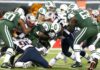

A hurricane doesn’t need to make landfall to reshape a Saturday in college football; it only needs a cone of uncertainty wide enough to force two athletic departments, a conference office, and the Secret Service to plan for a game that might not happen as scheduled.
Key Points
- A Gulf system — tracked by the National Hurricane Center with a 40% chance of tropical development — threatened to intensify into Tropical Storm or Hurricane Isaias ahead of the Alabama-Georgia game in Tuscaloosa.
- Alabama Athletics and the SEC both issued on-record statements confirming active monitoring, while stating no decision had been made to alter the game.
- Veteran meteorologist James Spann said relocating or rescheduling the game was genuinely “on the table,” citing possible wind gusts to 50 mph and isolated tornadoes.
- President Trump’s planned attendance in Tuscaloosa added a layer of security and logistical complexity on top of the weather question.
- The episode echoes a real SEC precedent: Hurricane Matthew forced the conference to postpone and relocate games in 2016, showing the league does act on storm threats rather than simply absorbing them.
What Was Actually Unfolding in the Gulf
The system in question began as an unassuming disturbance over the Bay of Campeche and the Yucatan Peninsula, the kind of warm, disorganized moisture pocket the National Hurricane Center tracks dozens of times each season without incident. By the week of the game, however, the NHC had attached a 40% probability of development to the system, and models — including the influential European model — had started nudging its projected track toward the central Gulf Coast, with Louisiana, Mississippi, Alabama, and the Florida Panhandle all inside the range of plausible outcomes. That is a wide net, and it is precisely why Alabama’s campus meteorological community, led by James Spann, treated the threat as real well before the storm had even earned a name.
Spann’s public comments carried unusual weight because he has spent decades building credibility with Alabama audiences specifically on severe-weather calls — tornadoes, in particular. His assessment that the game could face wind gusts up to 50 mph and isolated tornadoes if a Category 1 or 2 storm tracked near Mobile Bay was not alarmism; it was a conditional forecast tied to a specific, if still uncertain, storm path. He was equally candid about the limits of that confidence, telling AL.com that “there’s not enough confidence in a forecast to make any decision right now” and that updated Hurricane Center data would be needed before anyone could commit to a plan.
How Alabama and the SEC Actually Responded
Alabama Athletics’ public statement was notable less for what it said than for how carefully it said it: “Alabama athletics is closely monitoring the weather forecast ahead of Saturday’s football game vs. Georgia. At this time, there are no plans to alter the contest. We will continue to observe conditions throughout the week and remain in communication with the Southeastern Conference office, as needed”. That is institutional language built to avoid overcommitting in either direction — not dismissive of the threat, not alarmed by it either. The SEC’s own statement mirrored that tone almost exactly, noting the conference was “keeping an eye on forecasts and staying in communication with schools with games that could be impacted by weather,” language the league reuses nearly every week during hurricane season.
That pattern of institutional caution is not evasion; it reflects how decision authority in college football is genuinely structured. No single office owns the call. The SEC coordinates logistics and precedent, the host university manages stadium operations and local safety, and outside meteorologists supply the forecast confidence that ultimately drives the decision. Reporting around the game noted that moving it would be “a very rare measure, used only in extreme circumstances” — not a routine contingency, but not an unprecedented one either.
The Precedent That Matters
Skeptics inclined to dismiss hurricane disruption to a marquee SEC broadcast should look at 2016. When Hurricane Matthew bore down on the Southeast that October, the conference postponed LSU-Florida and moved Georgia-South Carolina to Sunday, citing player and fan safety over the financial and broadcast consequences of disrupting a full slate of games. That decision established that the SEC will, in fact, override its own schedule when forecast confidence crosses a certain threshold — it simply will not do so prematurely, before the storm’s track has firmed up. The Alabama-Georgia situation unfolded along the same logic: watch, communicate, and reserve judgment until the Hurricane Center’s advisories narrow the range of outcomes enough to justify disrupting a nationally televised rivalry game.
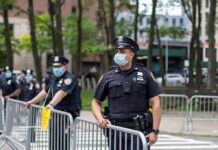
Complicating factors made this particular case more fraught than most. President Trump’s planned attendance in Tuscaloosa meant Secret Service coordination was already underway on campus, adding a security dimension to any decision about timing or venue. Alternative relocation sites were constrained by competing commitments elsewhere in the region — an MLS fixture and an NFL game occupying venues that might otherwise have offered a backup location — while a Zac Brown Band concert in Auburn and the long-running National Shrimp Festival in Gulf Shores meant the storm threatened far more than one football game across the state that weekend.
TUESDAY EVENING NOTES….
*Tropical Depression Nine is forecast to become Hurricane Isaias by Thursday, with landfall near the Alabama Gulf Coast late Friday night or Saturday morning.
*NHC is forecasting Isaias to reach category two strength with winds of 100 mph south of the… pic.twitter.com/Tbk3vkeo7t
— James Spann (@spann) October 6, 2026
Why the “Monitoring” Phase Is the Real Story
It is tempting, in hindsight, to want a cleaner narrative — either the storm hit and the game moved, or it missed and nothing happened. But the actual value of this episode lies in the week itself: the period when forecasters, administrators, and security officials had to make real decisions under incomplete information. Spann’s suggestion that a Sunday night kickoff might be the “best choice” if the storm’s timing shifted even modestly illustrates how much a single day’s delay can defuse a safety problem without requiring a full relocation. That kind of flexible contingency planning, quietly built in the background while public statements stayed neutral, is how major college programs actually manage storm risk — not through dramatic last-minute scrambles, but through staged options held in reserve until the data demands a choice.
The broader lesson for anyone who follows college football through hurricane season is that institutional caution and genuine risk assessment are not in tension; they are the same process, just communicated differently to different audiences. Meteorologists speak in probabilities and tracks. Athletic departments speak in operational status. Both were doing their jobs as the Gulf system churned toward the coast — and both converged on the same conclusion: wait for the data, then decide.
Sources:
covers.com, sports.yahoo.com, newsbreak.com, cbssports.com, abc3340.com, saturdaydownsouth.com