

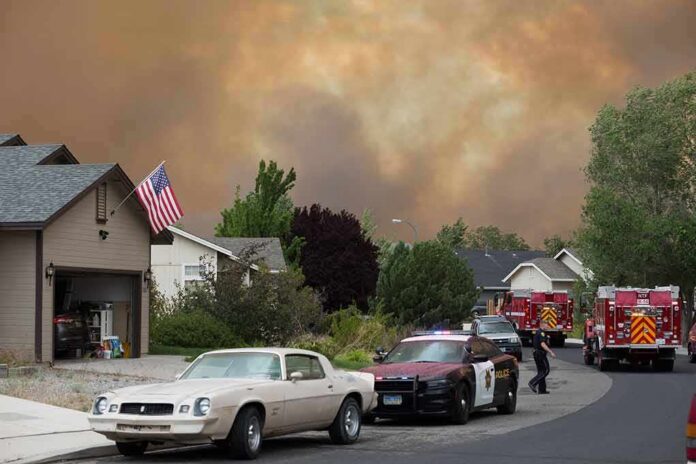
When 40,000 Californians are suddenly told to flee their homes because a single chemical tank might blow, it is hard not to wonder how many other invisible industrial risks are sitting next to American neighborhoods without anyone really watching.
Story Snapshot
- About 40,000 residents in six Orange County cities were ordered to evacuate after a volatile chemical leaked at an aerospace facility in Garden Grove.[1][2]
- Officials warned a storage tank of methyl methacrylate was “in crisis” and could either rupture or explode, despite no confirmed toxic plume at the time.[2][4]
- Broken or inoperable valves and cooling failures at the site raised questions about maintenance and regulatory oversight.[1][4]
- Multi‑agency control of information, spotty details on chemical quantities, and missing technical records fuel bipartisan distrust of how industrial risks are managed.[1][2]
What Actually Happened in Garden Grove
Local authorities in Garden Grove, a city in Orange County southeast of Los Angeles, ordered evacuations after a storage tank of methyl methacrylate, a volatile and flammable industrial chemical used to make acrylic plastics, began overheating and venting vapors at an aerospace manufacturing facility operated by GKN Aerospace.[1][2][4] Officials said the leak started Thursday afternoon and worsened Friday, forcing them to expand evacuation zones into parts of Anaheim, Buena Park, Cypress, Stanton and Westminster as conditions remained unstable.[1][2]
Fire officials described the tank as being in an active state of crisis and repeatedly warned that it would either fail and spill thousands of gallons of toxic liquid into the surrounding area or go into “thermal runaway” and potentially explode, affecting nearby tanks holding fuel or other chemicals.[2][3][4] Authorities emphasized there was no large, sustained toxic plume at the time, but they argued the credible risk of a catastrophic failure justified evacuation rather than shelter‑in‑place for nearby residents and schools.[2][4]
How First Responders Fought the Clock
Orange County fire crews and hazardous materials teams focused on cooling the compromised tank and trying to stabilize its pressure while preventing any major spill from reaching storm drains, creeks, or the nearby ocean.[1][2][3] Responders used a “curtain” of water streams and sprinkled systems to lower the tank’s temperature, buying time while engineers and chemical experts assessed options.[2][3] Officials deployed sandbags and other containment measures around the facility, and environmental agencies installed air‑monitoring equipment to track any spread of contaminants beyond the evacuation zone.[1][2]
Emergency managers acknowledged that equipment issues inside the plant complicated their work. Reports cited an inoperable or damaged valve on the tank, which they said prevented complete mitigation and made it harder to offload the remaining chemical inventory safely.[1][4] Authorities also noted a cooling system failure, and they publicly admitted uncertainty about how much methyl methacrylate remained in the tank, with varying estimates of total volume circulating in different briefings and media accounts.[1][2] That uncertainty reinforced the decision to maintain the evacuation until the tank could be fully stabilized.[2][4]
Disruption, Distrust, and the Bigger Oversight Problem
The large‑scale evacuation caused widespread disruption across western Orange County, shutting multiple campuses in the Garden Grove Unified School District and forcing families in at least six cities to leave their homes or shelter at hastily opened evacuation centers.[1][2][3] Health officials warned that short‑term exposure to methyl methacrylate vapors can irritate lungs and nasal passages and cause nausea or dizziness, with high exposure potentially leading to severe respiratory distress and hospitalization, though no injuries or deaths were reported as of the latest briefings.[2]
(12100 Western Ave) 34,000-Gallon Chemical Tank Leak Prompts Expanded Evacuation Orders Near Aerospace Facility in Garden Grove – reported on Citizen https://t.co/LltCCnkeQL
— Perfetto Sauce (@PerfettoSauce) May 23, 2026
This incident highlights a familiar pattern that frustrates Americans on both the right and the left: regulators and companies allow large quantities of hazardous chemicals to sit near homes, schools, and small businesses, yet the public only discovers the true risks when something goes wrong. Garden Grove residents are now learning after the fact about broken valves, failed cooling systems, and inconsistent chemical volume numbers, while key records—like maintenance logs, inspection reports, and detailed air‑monitoring data—have not yet been released for independent scrutiny.[1][2][4]
Why This Matters Beyond One California Neighborhood
Industrial accidents like this feed a growing belief that powerful corporations, regulators, and emergency agencies will protect their own reputations first and explain the full truth later, if ever. Early coverage of the Garden Grove leak leans heavily on official talking points, framing the event as an unprecedented emergency requiring broad evacuation, without yet answering deeper questions about prevention, inspection, and accountability.[1][2][4] With multiple agencies sharing responsibility, it may prove difficult for residents to pin down who, if anyone, failed them before the tank entered “crisis” mode.
For conservatives who already distrust environmental regulators and view California’s political class as more focused on climate headlines than practical safety, a near‑disaster at an aerospace plant looks like more bureaucratic failure. For liberals who worry about corporate shortcuts and environmental injustice, thousands of working‑class families forced from their homes by a private company’s tank only reinforces fears that industrial risks are quietly shifted onto ordinary people. Both sides see the same pattern: Americans are told to trust systems they do not control, then pay the price when those systems falter.
What to Watch for Next
Going forward, the most important facts will not come from another dramatic press conference, but from dry, technical documents: incident command logs, environmental sampling results, facility maintenance histories, and any state or federal investigation reports. Those records will show whether the Garden Grove evacuation was an unavoidable freak emergency or the result of neglected equipment and lax oversight.[1][2][4] Until they are public, the incident will stand as one more reminder that serious hazards can exist right next to American neighborhoods, largely out of sight and out of the public’s control.
Sources:
[1] Web – Thousands evacuated around leaking Orange County chemical tank
[2] Web – School closures, evacuations prompted by chemical leak in Garden …
[3] Web – 40,000 people evacuated due to toxic chemical leak at … – Audacy
[4] Web – Evacuation orders issued in California city over chemical tank