

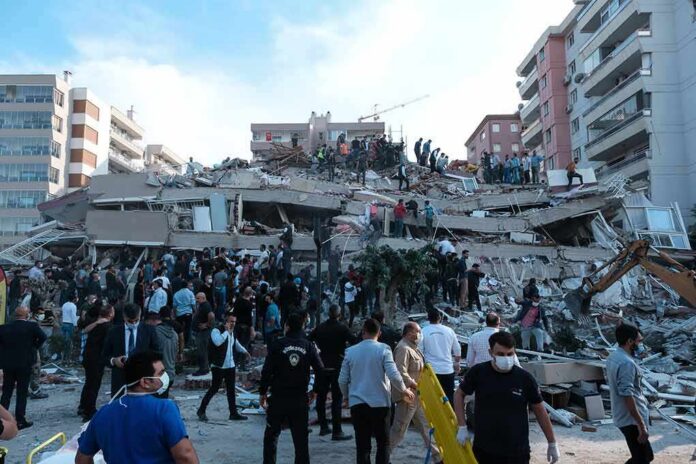
A tiny newborn pulled from Venezuelan earthquake rubble is now a global symbol of hope—and of how broken disaster reporting and government transparency have become.
Story Snapshot
- An 18-day-old baby and his mother were rescued alive 32 hours after Venezuela’s twin earthquakes.
- Video shows the baby reunited with his father, becoming a rare bright moment in a deadly disaster.
- Conflicting reports about a “9-month-old” rescue highlight how chaotic, confusing narratives spread in crises.
- Lack of clear data from Venezuelan authorities deepens public distrust of both governments and media.
Miracle Rescue In A City Buried By Quakes
Rescue workers in La Guaira, a coastal city north of Caracas, pulled a newborn baby alive from the rubble roughly 32 hours after twin earthquakes shattered northern Venezuela.[5] Video shared on social media shows crews working under floodlights on a collapsed apartment building, then carefully lifting the infant and passing him between rescuers as onlookers cheer.[5] The baby is described as just 18 days old and reportedly uninjured despite being trapped under debris for more than a day.[5]
News outlets from Asia to Africa picked up the same footage and story, reinforcing key details: the baby’s age, the 32-hour timeline, and the location in La Guaira.[1] Several reports cite the original Instagram user, identified as Andreina Quintero, as the person who posted the video and described the child as 18 days old.[1] A follow-up clip shows the baby under medical care, wrapped in a blanket and examined by health workers who say he appears free of serious injuries.[8]
Mother’s Survival And Emotional Reunion With Father
The infant’s mother was still buried under the building when rescuers found her son.[1] According to reports based on the same social media videos, teams continued digging and freed the mother roughly an hour to ninety minutes after the baby’s rescue.[1] She was taken to a local hospital, where video shows her in bed as a medic explains that her baby seems unharmed and suggests she shielded him with her body or another object.[8]
Other coverage focuses on the father’s role and the emotional impact of the rescue.[7] One widely shared clip shows the baby being carried through dust and broken concrete, then handed to a man identified as the child’s father.[4] He hugs the baby tightly as people around them applaud, a brief moment of joy against a backdrop of mass death and thousands still missing.[7] Commenters across social media call the survival of all three family members a “miracle” and praise the courage of local and foreign rescue crews.[7]
Disaster Scale And Confusing, Conflicting Narratives
The human drama of this rescue stands out because the larger earthquake picture is grim. Two quakes, measured at magnitudes 7.2 and 7.5, struck within minutes of each other, destroying homes and infrastructure across northern Venezuela.[9] By Saturday morning, the reported death toll had reached at least 1,430, with several thousand people injured and tens of thousands listed as missing.[9] Many families still search rubble with their bare hands, afraid their loved ones will never be found.[9]
At the same time, a separate rescue story has caused confusion. A United States search and rescue team from Virginia appears in another video pulling a mother and a baby from rubble, with reporters there saying the child is nine months old.[1] That clip shows American responders working alongside Venezuelan firefighters, and news scripts clearly describe a “9-month-old baby,” not a newborn.[1] Because both events feature a mother, an infant, and dramatic footage, some outlets and posts have blurred the two stories together.
Why The Details Matter In An Age Of Deep Distrust
Several international reports on the newborn rescue acknowledge that core facts—age, timing, and location—come from social media posts, not official government records or hospital logs.[5] They do not list the names of the parents, the hospital, or any rescue commander on the record.[5] A Christian news site later identified the mother as Dayana Patiño and the baby as Juan David, but even that account still relies heavily on volunteer testimony and video rather than publicly released state documents.[3]
"Venezuela earthquake miracle": An 18-day-old baby was found alive after spending 32 hours trapped under rubble in La Guaira.
His mother had covered him when the earthquake struck, saving his life. Ninety minutes later, she too was pulled out alive.
In the middle of so much… pic.twitter.com/sedsh05OAH
— CitizenGO Africa (@CitizenGOAfrica) June 29, 2026
This kind of information gap feeds anger on both the left and the right. Many Americans already believe elites and government agencies hide the truth or spin it for their own image. In Venezuela, officials have announced rising death tolls but have not released detailed rescue logs, survivor lists, or clear data about where and how people were saved.[9] When real heroism happens—like a mother and newborn surviving 32 hours in rubble—it reaches the world mainly through shaky phone videos and secondhand reports.
Pattern Seen In Other Disasters: Stories Merge, Trust Cracks
Researchers who study disasters say this kind of narrative confusion is common in major crises.[15] When many people are trapped, communications are broken, and government reporting is slow, social media and television often become the main record of who was rescued and where.[15] Under pressure to tell powerful human stories fast, outlets repeat dramatic claims that can mix details from different events, like the newborn in La Guaira and the separate nine-month-old rescue involving United States teams.
Studies of past disasters such as Hurricane Harvey show that rescue requests and survival often follow clear social patterns: families with young children and people in poverty are more likely to need help and to be trapped.[15] Yet the way these rescues are told to the public can be messy and emotional rather than precise. That messiness matters. It makes many citizens feel that they are fed inspiring clips while the hard numbers—who was saved, who was lost, and how officials performed—stay hidden or unclear.
What This Story Reveals About Failing Systems
The survival of an 18-day-old baby, his mother, and his father in a shattered Venezuelan city is a genuine victory for courage and human life.[6] It shows that even in a country hit by deadly quakes, where thousands remain missing, ordinary volunteers and professional crews can still beat the odds and bring families back together.[6] For many viewers, that is the kind of story they want to see more often, instead of endless political fights and elite power games.
But the shaky path this story took to the public—confused with another rescue, lacking clear official backing, carried mainly by viral clips—also shows how weak our information systems have become. Governments delay or hide detailed data. Media rush to package “miracles” without sorting out conflicting facts. In that gap, distrust grows. People who already think the system is rigged see one more example of institutions that can move mountains when cameras roll, but struggle to give citizens simple, honest answers when it counts most.
Sources:
[1] YouTube – Mother and 18-day-old baby rescued from rubble 32 hours after …
[3] Web – An 18-day-old baby was rescued from the rubble of a building … – …
[4] YouTube – Watch the moment 18-day-old baby rescued from rubble in Venezuela
[5] Web – Baby pulled alive from rubble after Venezuela earthquakes
[6] Web – A newborn baby and the child’s mother were rescued alive from …
[7] Web – An 18-day-old baby was rescued from the rubble of a building … – …
[8] Web – An 18-day-old baby was rescued from the rubble of a building … – …
[9] Web – US search and rescue teams working alongside local firefighters pulled …
[15] Web – An 18-day-old baby was rescued from the rubble of a building … – …