
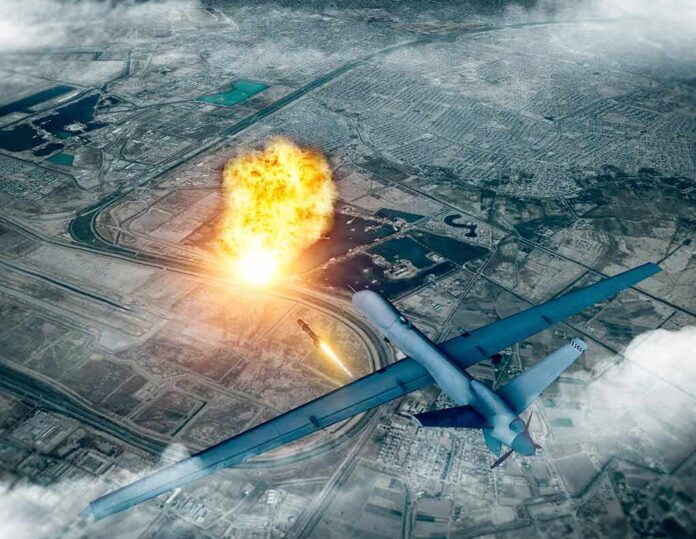
A missile blast forced an evacuation at Riyadh’s main airport and left civilians wounded as both sides issued clashing claims over what hit and why.
Story Snapshot
- Witnesses reported evacuation and smoke at King Khalid International Airport in Riyadh during an attack window.
- Houthi forces said they targeted the airport with a ballistic missile and warned airlines about Saudi airspace.
- Saudi authorities reported civilian deaths and injuries from airport attacks across the week, including at Riyadh.
- Coalition officials said two missiles fired toward Riyadh were intercepted, with debris causing additional damage.
What Happened At The Airport
Reuters and the Associated Press reported disruption at King Khalid International Airport on October 8, including an evacuation and smoke from an aircraft on the tarmac. The reports described delays, flight cancellations, and visible damage consistent with a security incident. An official told Reuters a missile struck the passenger terminal, injuring several people, while details on exact numbers varied across outlets that day. Saudi authorities did not immediately release a complete public damage report specific to the terminal event.
Houthi military spokesman Brigadier General Yahya Saree said their forces fired a ballistic missile at King Khalid International Airport and that it hit its target. He also warned aviation companies to avoid Saudi airspace as part of a broader campaign against airports in Riyadh and Najran. The Houthi statement did not include technical proof such as missile fragments, telemetry, or geolocated impact images, leaving key strike details unverified in open sources.
Saudi And Coalition Accounts
Saudi civil aviation officials later said attacks on airports killed three Saudi nationals and wounded others of several nationalities, with one account describing separate hits on airport facilities and a Saudia aircraft during the week’s escalation. The Saudi-led coalition spokesman said two ballistic missiles launched toward Riyadh were intercepted and destroyed, framing the events as attacks on civilian infrastructure. Saudi Civil Defense said falling debris from intercepted missiles damaged a kindergarten and a medical clinic complex in Riyadh.
These statements show partial overlap and key differences. They support that missiles were launched toward Riyadh while disputing whether a warhead directly struck the intended airport target. The accounts also suggest that some injuries and damage could stem from interception debris rather than a direct hit, a known risk in air defense events near cities. Specific, incident-by-incident casualty assignments for the Riyadh terminal blast remained fluid across early reports.
Why The Conflicting Claims Matter
The public saw grounded flights, injured travelers, and smoke over a major civilian hub. That visible harm fuels anger on both the right and the left, who already believe powerful actors play by different rules while ordinary people pay the price. The attacker said the strike was precise, while the defender said the missiles were stopped. Both accounts can be partly true in missile warfare, where debris can still injure civilians even after an interception.
*Breaking: Reports of casualties after Houthi missile strike on Riyadh airport:*
Reports from Saudi Arabia say missiles fired by the Houthis struck King Khalid International Airport in Riyadh.
Footage from the airport shows evacuations and a large emergency response, with… pic.twitter.com/yWuaSyrEqi
— (((IsraelMatzav))) (@IsraelMatzav) October 10, 2026
Clear answers require evidence that neither side has fully shared in public. Airport camera footage, air defense radar tracks, and verified debris analysis could show whether a warhead hit the terminal or if fragments caused the worst damage. Until that record appears, the safest read is narrow and factual: missiles were fired toward Riyadh; airport operations were disrupted; civilians were hurt; and officials disagree on whether the airport took a direct hit.
What This Means For Travelers, Markets, And Policy
Airlines must weigh the rising risk to Saudi airspace, with regulators abroad widening caution zones after recent attacks. Travelers should expect diversions or cancellations if threats persist. Energy markets watch these strikes closely because Saudi transport disruptions can rattle supply routes. United States leaders face pressure from both hawks and doves: to deter attacks on civilians while avoiding deeper military entanglement. The shared public concern is simple: protect people first, and prove claims with facts on the record.
Sources:
military.com, reuters.com, apnews.com, rmb.reuters.com, nytimes.com, dw.com, mea.gov.in, saudigazette.com.sa, arabnews.com