
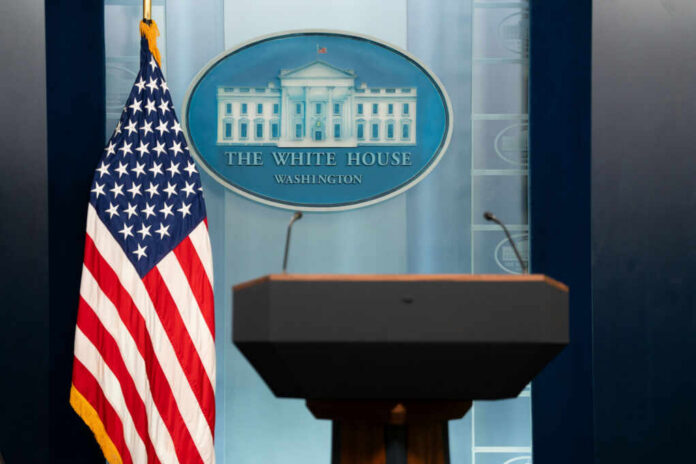
The White House is scrambling to shut down nuclear-war rumors after a few carefully chosen words from Vice President JD Vance ignited speculation at the worst possible moment.
Quick Take
- The White House issued a formal denial that the U.S. is considering nuclear strikes on Iran after Vance referenced unused “tools in our toolkit.”
- The denial landed as President Trump’s ultimatum for Iran to reopen the Strait of Hormuz approached an 8 p.m. ET deadline on April 7, 2026.
- Operation Epic Fury, launched in late February 2026, has been described by U.S. officials as a conventional campaign targeting missiles, naval capability, and proxy support.
- The episode highlights how fast online interpretation can distort deterrence messaging—and how quickly the administration will publicly correct it.
White House Moves Fast to Quash Nuclear Speculation
Washington’s latest Iran flashpoint came from messaging, not a new battlefield event. After Vice President JD Vance spoke in Budapest about “tools in our toolkit that we so far haven’t decided to use,” some political opponents and commentators argued the remark hinted at nuclear options. Within hours, the White House issued a firm denial and emphasized that U.S. operations and pressure tools remain conventional, seeking to prevent the rumor from hardening into “fact” online.
The White House also took the unusual step of publicly rebuking the interpretation in blunt terms on social media, signaling urgency about controlling escalation narratives. That sharp tone matters because mixed signals can cause real-world consequences—markets, allies, and adversaries all watch the same clips and headlines. The administration’s posture, based on the reporting available, was not to expand the menu of threats but to narrow it back to conventional military capability and diplomatic leverage.
Trump’s Strait of Hormuz Deadline Raises the Stakes
President Trump’s ultimatum for Iran to reopen the Strait of Hormuz added pressure to every word coming from senior officials. Reports described the strait as strategically crucial, with direct implications for global energy flows and international shipping. Trump set an 8 p.m. ET deadline for compliance on April 7, 2026, alongside warnings of severe consequences if Iran refused. The resulting environment made any ambiguous language—especially about unused “tools”—politically combustible.
Trump also threatened large-scale strikes on Iranian infrastructure, with reporting citing potential targets such as power plants and bridges. Those threats remain within the bounds of conventional warfare, but they still carry significant humanitarian and economic implications. For American voters already exhausted by years of instability and inflation, the connection to energy prices is not theoretical: disruptions around Hormuz can quickly feed higher fuel costs, shipping costs, and broader consumer price pressure.
Operation Epic Fury: Conventional Campaign, High-Risk Theater
Operation Epic Fury, launched in late February 2026, has been portrayed by U.S. officials as a major but limited campaign aimed at degrading Iran’s missile capabilities, neutralizing parts of its navy, curbing support for terrorist proxies, and preventing Iran from acquiring a nuclear weapon. Officials also indicated the U.S. had largely achieved core objectives, while acknowledging remaining work tied to Iranian weapons manufacturing capability.
Those objectives illustrate the administration’s balancing act: applying maximum pressure without widening the conflict into something open-ended. Conservatives who favor peace through strength often support clear military goals and decisive deterrence, but they also tend to reject mission creep and vague nation-building. Based on the reporting available, the administration is emphasizing that the campaign is targeted and conventional, even as it keeps leverage through deadlines, additional pressure options, and continued readiness.
Why the Messaging Fight Matters to Both Parties—and the Public
The political fight over what Vance “meant” shows a modern reality: narratives can race ahead of verified policy, and official corrections may not catch up. The White House’s denial suggests it believed the nuclear interpretation could complicate diplomacy, alarm allies, or invite miscalculation from Iran. Reports also indicated ongoing backchannel diplomacy involving U.S. officials and intermediaries, meaning credibility and clarity are not academic—they are negotiating tools.
The deeper takeaway is less about any single quote and more about trust. Many Americans across the right and left suspect elites and institutions manipulate information, then demand the public accept shifting explanations. In this case, multiple outlets reported consistent core facts—Vance’s phrasing, the denial, the ultimatum, and the ongoing operation—while also acknowledging the genuine ambiguity created by “tools” language. For citizens trying to judge competence, the standard should be simple: clear goals, clear limits, and fewer avoidable messaging errors.
Sources:
White House denies considering use of nuclear weapons in Iran after Trump fresh warning
White House denies nuclear strike speculation on Iran
White House denies plans for nuclear strike on Iran
White House denies plans for nuclear strike on Iran
White House denies considering nuclear strikes on Iran