
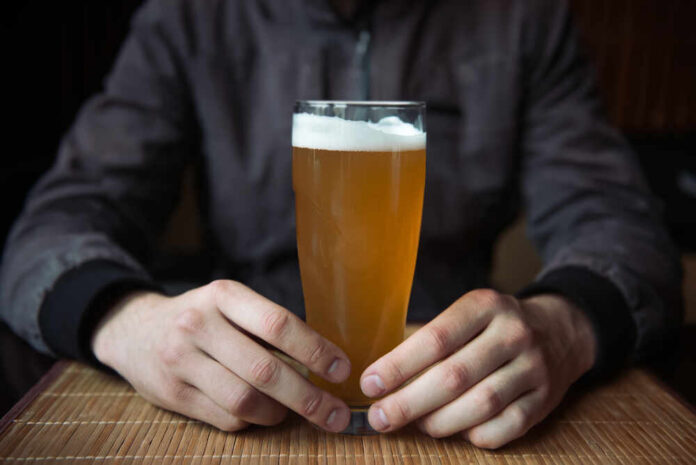
Scottish fans did not just pack Boston bars. They also turned a routine World Cup weekend into a beer shortage story that spread fast.
Quick Take
- Boston Beer Co. said its Sam Adams Taproom ran out of Boston Lager after Scotland fans drank four times the usual amount over four days.
- Several Boston venues, including The White Bull Tavern, Hennessy’s Bar, Federal Wine & Spirits, and The Dubliner, also reported running low or running out.
- The evidence comes mostly from bar managers, brewery statements, and local news footage, not from audited sales records.
- The story shows how a real sales spike can quickly grow into a bigger claim about a whole city.
Boston Bars Felt the Pressure Fast
Boston Beer Co. said its Boston Taproom sold four times the normal amount of Boston Lager during a four-day stretch, and it had to schedule an emergency delivery on Saturday morning [1][4]. NBC News and ESPN reported that the taproom ran out because Scotland fans were in town for the 2026 World Cup [2][4]. The same reporting said the taproom was not alone, which helped turn one venue problem into a wider local news story.
Other Boston businesses described the same kind of strain. NBC News and ESPN quoted The White Bull Tavern saying it “ran out of everything,” while a Scottish fan said the crowd had “drank the place dry” [2][4]. Hennessy’s Bar told The Boston Globe that sales tripled St. Patrick’s Day and that it sold out by Sunday night [2][4]. Federal Wine & Spirits also reported running out of Budweiser and Corona on Saturday [2][4].
What the Reporting Shows, and What It Does Not
The strongest proof in this story is eyewitness reporting from bar managers and brewery staff, not a citywide inventory audit. The supplied coverage does not include point-of-sale logs, distributor invoices, or independent counts of how much beer Scottish fans bought versus other customers. That matters, because the reports show a real demand spike, but they do not prove every empty keg came from one group alone. The available record supports a local shortage, not a measured citywide crisis.
That distinction matters in Boston because sports weekends already bring heavy drinking. Research in the provided context says sports fans often drink more during games and at bars, especially when they gather in groups. In this case, the dramatic framing came from repeated quotes and clips, which made the story travel faster than the evidence behind it. The result is a familiar media pattern: a real event gets simplified into a bigger, cleaner headline.
Why the Story Spread So Quickly
This kind of story grabs attention because it fits a simple script. A loud fan base arrives. Beer disappears. Bar staff give colorful quotes. The Boston case had all of that, plus video clips that showed staff joking that Scots were “drinking this whole city dry” [3]. Once that line entered the news cycle, other outlets repeated the same core details, which gave the impression of a citywide beer run even though the reporting stayed focused on a few venues.
🎉 Hats off or cones on! To the Tartan Army, Scotland’s legendary fans who’ve brought unbeatable cheer, kilts, bagpipes, and pure joy to New England and New York for the FIFA World Cup! 🏴⚽
Tens of thousands have descended on Boston and beyond, turning the city into a sea of… pic.twitter.com/8VsWTw7xtI
— Christopher McQuade (@McQuadeTX) June 21, 2026
There is also a broader public mood behind the story. People on both the left and the right often distrust polished public narratives, especially when they are driven by a few anecdotes and amplified by media outlets. In this case, the facts do show real strain on Boston bars. But the available evidence also shows how fast a vivid local scene can become a larger tale than the records can fully support.
Sources:
[1] Web – Boston bars are reportedly running out of beer as Scottish soccer fans …
[2] Web – Scotland fans drink Boston dry as local bars run out of beer – ESPN
[3] Web – Are Scottish soccer fans drinking all of the beer in Boston?
[4] YouTube – Boston bars run out of beer as Scotland fans overrun the city