A foreign leader’s “draft” slip-up on X is raising uncomfortable questions about who is really writing the script behind high-stakes Middle East diplomacy.
Quick Take
- Pakistan Prime Minister Shehbaz Sharif posted on X urging President Donald Trump to extend an Iran-related deadline by two weeks to allow diplomacy.
- X edit history showed Sharif’s post initially included a “Draft – Pakistan’s PM Message on X” prefix and wording that referred to him in the third person.
- The post was edited within minutes, but screenshots and timestamps fueled viral speculation about outside authorship.
- Trump later announced a two-week pause on attacks, citing conversations with Sharif and Pakistan’s Field Marshal Asim Munir.
The “Draft” Edit That Sparked a Credibility Fight
Pakistan Prime Minister Shehbaz Sharif’s ceasefire-related message on X became a story not just for what it asked, but for what its edit history revealed. The post urged President Donald Trump to extend a deadline for attacks on Iran by two weeks so diplomacy could continue, while also calling for Iran to open the Strait of Hormuz and for a broader ceasefire. Viewers quickly noticed the initial version appeared to include “Draft – Pakistan’s PM Message on X,” along with third-person phrasing.
According to reporting that highlighted timestamped edits, the “draft” prefix was removed within about a minute, and a subsequent edit reordered the tagged U.S. officials. The speed of the cleanup is part of why the incident caught fire: it looked less like a careful government statement and more like a pasted text that accidentally exposed its origin. None of the available reporting conclusively identifies who wrote the draft, leaving a gap between suspicion and proof.
Why the Strait of Hormuz Demand Matters to Americans
The Strait of Hormuz is a critical chokepoint for global energy flows, so any talk of opening—or threatening—shipping lanes can ripple through oil markets and ultimately hit Americans in gasoline and home-heating costs. In that context, Sharif’s call for Iran to open the strait functioned as a diplomatic “deliverable” that would signal de-escalation and reduce pressure for military action. For voters already angry about inflation and energy prices, stability in Hormuz is not an abstract foreign-policy issue.
Trump’s Two-Week Pause and Pakistan’s Mediation Role
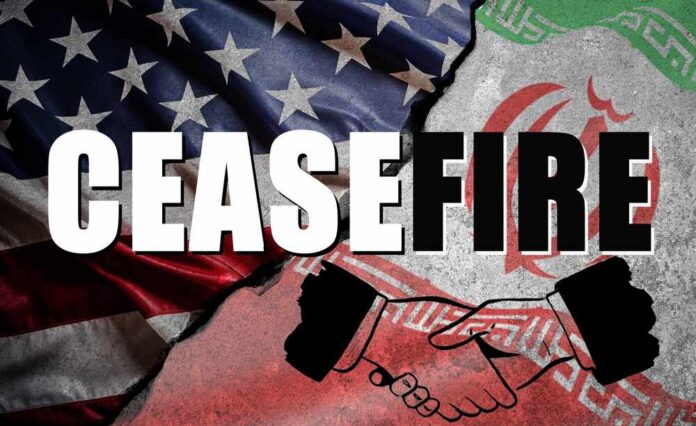
Sharif’s X post preceded Trump’s announcement of a two-week suspension of attacks, described as conditional on Iran’s behavior and linked to discussions with Sharif and Field Marshal Asim Munir. The sequencing strengthened the perception that Pakistan was positioning itself as a broker between Washington and Tehran, leveraging its ties in the region. Supporters of an America First approach may see value in short, clearly defined pauses that serve U.S. interests—so long as conditions are enforceable.
What the Edit History Suggests—and What It Doesn’t
The most serious implication is not the typo itself, but the possibility that a foreign leader’s public diplomacy is being shaped externally. The edit history and third-person phrasing are consistent with the post being prepared as a draft by someone other than Sharif personally, and possibly outside his government, as some coverage suggested. However, the evidence presented publicly does not prove authorship; it only demonstrates that a “draft” label and awkward phrasing briefly appeared before being removed.
A Bigger Lesson: Trust, “Deep State” Suspicions, and Digital Diplomacy
For many Americans—right and left—the incident feeds an already deep distrust that major decisions are made by elites and intermediaries rather than accountable leaders. Conservatives, in particular, have spent years warning that unelected actors can steer policy through messaging, bureaucracy, and media management. The Sharif edit episode doesn’t confirm any specific “deep state” narrative, but it does show how modern diplomacy increasingly runs through editable social platforms where mistakes instantly become geopolitical signals.
With no definitive proof of who authored the draft, the responsible takeaway is narrower but still important: credibility is now part of national security. When a ceasefire message looks copy-pasted, it can weaken public confidence, complicate negotiations, and hand propaganda wins to every side. In an era where screenshots move faster than diplomats, governments that want trust—especially in war-adjacent crises—have to treat their digital communications like formal state documents, not casual posts.
Sources:
Draft tag in Pakistan PM Shehbaz Sharif’s X post edit history raises questions
Copy-paste gone wrong: Pakistan PM Shehbaz Sharif’s ‘draft’ blunder on X over US-Iran ceasefire deal