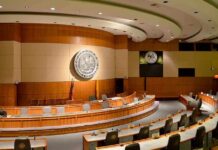
Virginia’s top court just blew up a Democratic redistricting plan—and the online left’s response quickly veered into “violent revolution” rhetoric that should alarm anyone who values political stability.
Quick Take
- The Virginia Supreme Court struck down a voter-approved, Democratic-backed mid-decade redistricting plan in a 4-3 decision, citing procedural violations.
- The invalidated map was designed to produce a 10-1 Democratic advantage in Virginia’s U.S. House delegation, according to reporting summarized in the research.
- Democrats signaled they plan to appeal to the U.S. Supreme Court, keeping legal and political uncertainty in place ahead of the 2026 midterms.
- Left-wing streamer Hasan Piker amplified tensions by invoking a quote suggesting violent revolution becomes “inevitable” when peaceful change is blocked.
Virginia Supreme Court voids mid-decade map over ballot procedure
Virginia’s Supreme Court invalidated a Democratic-backed redistricting plan by a 4-3 vote after finding procedural problems in how the constitutional amendment was placed before voters. The majority, authored by Justice D. Arthur Kelsey, concluded the violation “irreparably undermines the integrity of the resulting referendum vote.” The ruling leaves the voter-approved map void and keeps the prior map in effect for now, pending further legal moves.
Democrats argue the decision overrides the will of voters who narrowly approved the amendment on April 21, 2026. Republicans respond that constitutional rules for changing election law exist precisely to prevent shortcuts, even when a ballot question passes. For conservatives who worry about political manipulation of institutions, this case is a reminder that process matters because process is often where power is consolidated—quietly, and sometimes irreversibly.
Why a “10-1” map turned a state dispute into a national fight
The political stakes are not subtle. The challenged plan was expected to create a 10-1 advantage for Democrats in Virginia’s U.S. House seats, a shift large enough to ripple into national strategy ahead of the 2026 midterms. In Washington, small seat margins can determine committee control, investigative power, and the boundaries of federal spending. That is why the National Republican Congressional Committee and other groups treated the lawsuit as a high-priority target.
The fight also underscores a growing bipartisan cynicism: many Americans believe redistricting is less about “representation” than about entrenchment. Democrats frame the case in the language of voting rights and democratic participation, pointing to federal developments after the 2013 Shelby County v. Holder decision and later court rulings. Republicans emphasize constitutional compliance and argue that election rules cannot be bent simply because a party wants a more favorable map between regular census cycles.
Democrats vow appeal as the calendar tightens for 2026 races
Democrats have said they intend to appeal to the U.S. Supreme Court, but the timeline for federal review remains unclear based on the available reporting. That uncertainty matters because campaigns plan around district lines: candidates decide where to run, donors decide what to fund, and parties decide what to prioritize. When boundaries are unsettled, it can distort primaries, weaken accountability, and increase the sense that elections are being “engineered” rather than decided.
Revolution talk from a major streamer raises the temperature
Against that backdrop, the public reaction online became a story of its own. Hasan Piker, a prominent left-wing political streamer, posted the line “Those who make peaceful revolution impossible, make violent revolution inevitable,” a paraphrase of a well-known JFK-era formulation. Even when offered as rhetoric rather than instruction, that framing normalizes the idea that political loss is proof the system is illegitimate—and that escalation is justified. That is a dangerous trend regardless of party.
What’s provable—and what remains unproven in the media framing
The available sourcing supports several key facts: the 4-3 ruling, the procedural-breach rationale, the voter-approved amendment, the map’s intended partisan effect, and Piker’s post. What is not established is the broader insinuation that Democrats “adore” Piker or that party leadership endorses his rhetoric. That distinction matters because Americans can fairly debate election law without smearing every voter as an extremist. Still, leaders on both sides face pressure to condemn revolutionary language before it becomes a political norm.
Radical Leftist Adored by Democrats Pushes ‘Violent Revolution’ Following Court Decision Against Virginia Gerrymander
READ: https://t.co/NBaLwcTLNC pic.twitter.com/G9TPn3X3A7
— The Gateway Pundit (@gatewaypundit) May 9, 2026
The larger lesson for a country already exhausted by inflation, institutional distrust, and cultural conflict is simple: stability depends on accepting lawful outcomes and channeling disputes into elections and courts—not street-level intimidation or rhetorical flirtations with violence. Virginia’s case shows how quickly election-process fights can turn into legitimacy fights. If a functioning republic requires anything, it requires political actors—especially those with big platforms—to de-escalate rather than profit from outrage.
Sources:
Virginia Supreme Court strikes down Democrats’ redistricting plan