
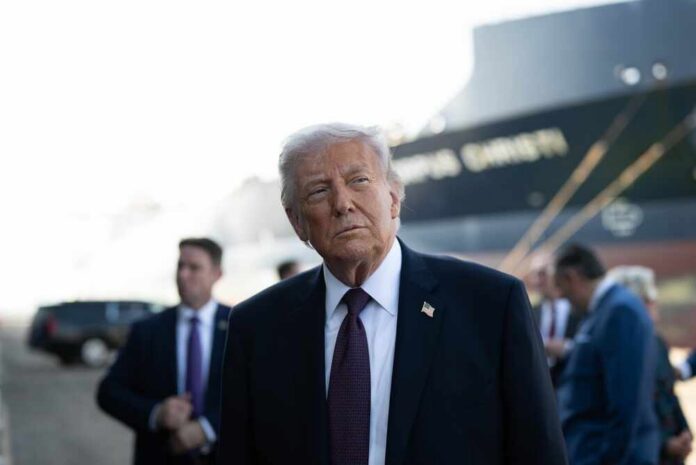
President Trump’s “permanent” Strait of Hormuz reopening headline is colliding with a hard reality: Iran is only promising access for days, not a lasting guarantee for the world’s most critical oil choke point.
Quick Take
- Trump says the Strait of Hormuz is “permanently” open, while Iran frames openness as temporary and tied to a 10-day ceasefire window.
- Before the crisis, more than 100 ships per day reportedly transited the strait; recent traffic has been described as only a handful daily.
- Trump publicly threatened major strikes on Iranian infrastructure if Iran did not reopen the waterway, raising escalation risks even amid “reopening” claims.
- European leaders welcomed the announcement but pushed for durable security, including a defensive maritime initiative discussed in Paris.
Why the “Reopening” Claim Is Being Questioned
President Donald Trump has taken credit for “permanently opening” the Strait of Hormuz, presenting it as a win for global trade and energy stability. Iran’s foreign minister, Abbas Araghchi, has also said the strait is open to commercial vessels—but under conditions and time limits tied to a 10-day ceasefire connected to Lebanon. That mismatch—permanent versus time-bound—explains why analysts and critics call the announcement more messaging than a durable change.
The skepticism is strengthened by basic observable metrics: shipping volume. Reporting cited in the available research describes a drop from pre-crisis traffic of more than 100 ships per day to only a handful of ships daily during the current conflict. If true, that gap matters more than press-conference language because it affects insurance rates, cargo scheduling, and fuel pricing. The bottom line for consumers is simple: a “reopen” that doesn’t restore confidence can still keep energy costs unstable.
Trump’s Pressure Campaign and the Escalation Risk
Trump’s position has combined public pressure with explicit deterrent threats. The research describes a March 21 ultimatum demanding Iran “FULLY OPEN” the strait within 48 hours or face U.S. strikes on power plants, followed by additional threats in early April against Iranian electric facilities, oil assets, Kharg Island, and desalination plants. Those statements underscore that access has been treated as coerced compliance, not a mutually accepted security arrangement with clear enforcement rules.
That posture may resonate with voters who prefer strength over drift, especially after years of global instability and Washington’s mixed track record policing international flashpoints. At the same time, coercive diplomacy can create a fragile “yes” that breaks the moment incentives change. The research also notes Trump questioning why the U.S. should keep doing the policing for countries that buy the oil—an argument for burden-sharing, but also a signal that long-term enforcement may be uncertain.
Europe’s Push for a Standing Security Plan
At the Paris conference described in the research, leaders including France’s Emmanuel Macron and the UK’s Keir Starmer reportedly welcomed the announcement but emphasized the need for permanence. The conference discussions included a “Strait of Hormuz Maritime Freedom of Navigation Initiative,” described as defensive and designed for non-belligerent participants. That structure reflects Europe’s concern that words alone will not keep shipping safe, and that a standing mechanism—rules, escorts, and coordination—may be needed to stabilize commerce.
This also highlights a political tension conservatives have watched for decades: U.S. power underwrites global trade, but allied governments often prefer U.S. involvement without paying the costs or accepting the risks. If a European-led initiative excludes the U.S. and Israel, it may reduce immediate political friction for participants, yet it can also complicate unity of command and accountability during a crisis. The research does not provide enough operational detail to judge capability, only intent.
What This Means for Oil Prices, Inflation, and Public Trust
Because the strait handles roughly 20% of global oil trade, even partial disruption can ripple quickly into prices, insurance premiums, and inflation expectations. The research indicates oil prices fell after Araghchi’s statement, which is consistent with markets reacting to any sign of reduced chokepoint risk. The key question is durability: if the “open” status depends on a 10-day ceasefire, markets can rebound just as fast—especially if threats resume or traffic fails to normalize.
The Strait of Hormuz ‘Reopening’ Is Just a PR Stunthttps://t.co/wJBcCRspC4
— Harry J. Kazianis (@GrecianFormula) April 17, 2026
For Americans already worn down by high living costs and a government that often feels performative, the competing narratives matter. Trump’s team can point to pressure producing movement; critics can point to the limited time window, low traffic, and unclear enforcement as evidence of spin. Based on the research provided, the strongest factual takeaway is not that the strait is securely “solved,” but that access remains conditional, politically leveraged, and vulnerable to rapid reversal.
Sources:
Reopening the Strait of Hormuz: Trump shifts responsibility off US
German Chancellor Merz seeks US involvement in a mission to secure the Strait of Hormuz