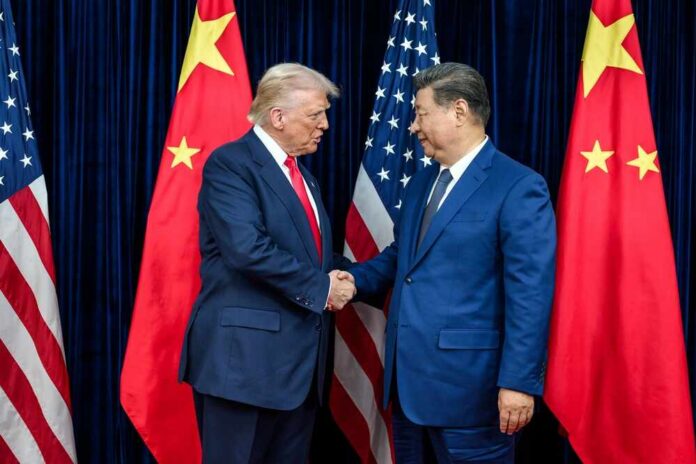
President Trump’s upcoming summit with China’s Xi Jinping threatens to put America’s decades-long commitment to Taiwan on the negotiating table in exchange for trade concessions, raising alarm bells among those who see the island democracy as a critical check against Beijing’s regional ambitions.
Story Snapshot
- Taiwan will be a central topic at the May 14-15 Trump-Xi summit in Beijing, with concerns Trump may trade Taiwan policy for economic deals
- Taiwan’s intelligence chief warns of Chinese “manoeuvring” to extract U.S. concessions on arms sales and defense commitments
- Secretary of State Marco Rubio confirms Taiwan discussions while emphasizing mutual interest in avoiding destabilization
- Pentagon assessment indicates China remains on track for potential 2027 invasion readiness, adding urgency to summit outcomes
Trump’s Transactional Approach Raises Taiwan Concerns
President Trump travels to Beijing on May 14-15 for high-stakes talks with Chinese President Xi Jinping, where Taiwan’s future hangs in the balance. Taiwan’s National Security Bureau Director-General Tsai Ming-yen warned parliament that China will likely maneuver to secure U.S. concessions on the island democracy. This follows Trump’s February 2026 suggestion that he might discuss Taiwan arms sales with Xi, a proposal that sent shockwaves through defense and diplomatic circles. The summit takes place amid ongoing tariff wars and Indo-Pacific tensions, with Beijing hosting to maximize its leverage on critical issues like rare earth exports and agricultural market access.
Strategic Ambiguity Under Pressure
The Trump administration’s approach tests America’s longstanding “strategic ambiguity” policy on Taiwan, established through the 1979 Taiwan Relations Act. This delicate balance neither confirms nor denies U.S. military defense of Taiwan while maintaining robust arms sales to the island. Secretary of State Marco Rubio stated Taiwan will be discussed but emphasized that neither side desires destabilizing events. Yet concerns persist that Trump’s deal-making instincts could prompt him to soften U.S. commitments in exchange for Chinese economic concessions. Taiwan’s Mainland Affairs Council official Liang Wen-chieh acknowledged China “very much wants” to discuss Taiwan, hoping the conversation stays manageable without undermining the island’s security.
The High Stakes for Regional Security
Any shift in U.S. Taiwan policy carries profound implications for Indo-Pacific stability and global economics. Taiwan produces the majority of advanced semiconductors through companies like TSMC, making disruption a potential catastrophe for the global tech supply chain valued at over two trillion dollars. Pentagon assessments indicate Xi Jinping remains on track for 2027 invasion readiness, adding urgency to maintaining credible deterrence. U.S. allies including Japan and the Philippines watch nervously, understanding that American retreat from Taiwan would signal broader unreliability across regional security commitments. The summit outcome will reveal whether transactional diplomacy can balance economic interests with strategic obligations, or if short-term deal-making risks long-term credibility.
A Test of American Resolve
The fundamental question facing Trump and his administration centers on whether America’s word remains binding when competing interests arise. Taiwan represents more than a geopolitical flashpoint; it embodies the principle that democracies deserve support against authoritarian pressure. Critics across the political spectrum worry that treating Taiwan as a bargaining chip undermines not just the island’s twenty-three million people, but America’s credibility with allies worldwide. Congress retains authority through the Taiwan Relations Act to check presidential concessions, yet Trump’s unpredictable negotiating style creates uncertainty. As the summit approaches, both supporters and skeptics wonder if principled commitments will hold firm against the temptation of immediate economic gains that might not address deeper structural problems in the U.S.-China relationship.
Sources:
Taiwan issue looms ahead of Donald Trump meeting with Xi – The Jerusalem Post
China may try ‘manoeuvring’ over Taiwan issue during Trump-Xi summit – The Independent
Ahead of Trump-Xi summit, Beijing puts Taiwan front and centre – Asia News Network